August 01, 2018

Lessons from Tham Luang Cave

"We're not sure if this was a miracle, science, or what."  

--Thai Navy SEALS posted on Facebook

A courageous and exhaustive 18-day rescue effort to bring 12 soccer players, aged 11 to 16, out of a treacherous cave in Mae Sai, Thailand, had an innocent beginning. A decision on June 23, 2018, to celebrate a team member's 16th birthday by exploring the Tham Luang Cave turned into ten days of uncertainty for the players, coach, families, and a watchful world.    

The dozen Thai boys, members of the "Wild Boars" soccer team, and their coach, Ekkapol Chantawong, were found on July 2. They were safely removed from the Tham Luang Cave but not without a lot of 12-hour days and the loss of a Thai Navy SEAL, 38-year-old Samarn Gunan, who died placing oxygen tanks along the passageway to make their rescue possible.  

News reports indicate that the head of at least one Hollywood production studio in Thailand is exploring ways to adapt this incredible story.


Image result for images of soccer boys in thailand
(C) Wild Boars Soccer Team, Mae Sai, Thailand AP 

What can we learn?


The military, and those in the cave rescue business (yes, that's a business), will spend time looking carefully at this near-tragedy. However, the death of diver Samarn Gunan is tragic. They will document the process, as we should try to learn from the experiences of others.  

Based on interviews with soccer players, coaches, families, and rescue workers, what can be gleaned from the miracle in Mae Sai?

1. Pay attention to warning signs. 

There are signs at the entrance to Tham Luang Cave warning visitors not to take risks. It's reported that locals are advised not to enter during the monsoon season, as the cave system rapidly floods with water. Additionally, parents advise their children to stay away from the cave.  

(There were weather warnings on July 19, 2018, ahead of the Duck Boat tragedy at Table Rock Lake in Branson, Missouri. Seventeen people died, including nine members of one family.)

The RMS Titanic, a British ship that sank on April 15, 1912, in the North Atlantic, had received several warnings about icebergs, but they were mostly ignored. As a result, nearly 1,500 passengers and crew lost their lives that night.  

Sometimes warning signs are posted; other times, they're not. If they are, we ignore them at our own peril and those under our care.

It's worth noting that consequences may be unintended — but also foreseen.  

2. Don't panic.  

Robert Laird, the co-founder of International Underwater Cave Rescue and Recovery, observed that "rescues are rare."  In an interview in The Atlantic, Laird says that when cave divers get in serious trouble, they usually die. "There is no one to rescue, just a body to recover," he adds.  

Notes Laird, "The worst thing you can do is panic."   

We know from interviews with the boys that the first few days were marked by intense panic. It was not until Day 3 that Coach Ek could get the soccer team to stop crying. After that, the focus shifted to quietness, deep breathing, and getting sleep. That emotional reversal created a frame of mind in which survival was possible.    

3. Admit the need for help.  

Military experts. International cave divers. Medical personnel. Farmers. And a Thai rock singer. They all played roles in the rescue effort.  

Narinthorn Na Bangchang, a popular entertainer from Bangkok, who had flown to Mae Sai, posted her equipment needs on her Facebook page. Bangchang's followers responded generously. For example, a request for 200 regulator air tanks resulted in 400 tanks being donated.  

She also found an expert cave diver who had trained the Thai Navy SEALs.     

In addition to pumps that removed billions of liters of water from the area to make the rescue possible, the retinue of resources included over 100 divers, 500 air tanks, 1,000 support personnel, 900 police officers, including police ambulances, and 5,000 meals each day for people on the ground.  

The Thai Navy SEALs are trained in open-water diving, not cave diving. They recognized a need for more specialized expertise and welcomed experienced volunteers.  

4. Persistence pays off. 

When the Thai Navy SEALS arrived at the cave on June 25, they had gotten inside as far as Pattaya Beach, a piece of dry ground four kilometers (2.1 miles) from the mouth of the cave. They found footprints and shoes confirming that the boys had passed this way.

When the SEALS decided to turn back due to a lack of air canisters and coming rain, they were just 400 meters (.2 miles) from where the boys and their coach had taken shelter.

Heavy rains would fill the cave in another week, before anyone could return.

However, giving up was not an option.

"We had to dive, walk, climb through stone and rock, but we had to keep fighting," says Thai SEAL Commander Arpakorn Yookongkaew.  "If we did not keep moving, there would be no hope for the children."  

Using guidelines set by Belgium-born Ben Reymenants and his diving partner, British divers finally found the boys and their coach on July 2. 

In the meantime, the soccer team exchanged letters with their parents, delivered by divers, which further encouraged the boys and their coach.

5. Technology has limitations.  

What about hi-tech?

"The Silicon Valley model for doing things is a mix of can-do optimism, a faith that expertise in one domain can be transferred seamlessly to another, and a preference for rapid, flashy, high-profile action. 

"But what got the kids and their coach out of the cave was a different model: a slower, more methodical, more narrowly specialized approach to problems," observed Dr. Zeynep Tufekci from the University of North Carolina.     

Dr. Tufekci also noted that a "safety culture" approach to problem-solving, combined with decades of training, enabled Chesley Sullenberger to safely land US Airways Flight 1549 in New York's Hudson River on January 15, 2009, without incurring any loss of life.

Undoubtedly, technology will have a role in future cave rescues. Still, it will likely support a "slow is smooth--and smooth is fast" approach used by a consortium of Navy SEALS and international cave rescue experts in Thailand. 

6. Leaders go last.

While in the cave, the soccer coach apologized to the parents in a handwritten note sent through divers. Coach Ek promised to take care of the children during the rescue mission "as best I can." And he did.


Image result for coach ek images thailand
(C) Coach Ek. Ek Facebook Page

It was fitting that the coach was with the last four boys to be rescued on July 10. Staying behind until everyone was safely removed was the right thing to do.  

No doubt Coach Ek, who was orphaned at the age of 10, will have plenty to reflect on regarding his decision to enter the Tham Luang Cave with the soccer team. Successful leaders make mistakes, but they don't repeat the same mistakes twice.

A lesson for everyone is summed up by the late actor and social commentator Will Rogers, who, in a different era and a world away, once said, "Good judgment comes from experience, and a lot of that comes from bad judgment."       


Strategist.com

©  Bredholt & Co.  


July 01, 2018

Trends Worth Watching

Here are 10 U.S. and global demographic trends that may be of interest to you:

1. Millennials are projected to be the U.S.'s largest living adult generation in 2019. More than Baby Boomers. millennials are already the largest generation in the U.S. labor force, making up 35% of the total. 

2. Americans are more racially and ethnically diverse than in the past. The U.S. is projected to be even more varied in the coming decades. By 2055, the U.S. will not have a single racial or ethnic majority. 

3. Americans' lives at home are changing. After a decades-long trend, just half of U.S. adults were married in 2015, down from 70% in 1950. Moreover, with marriage in decline, cohabitation is increasing, with the most significant gains among those ages 50 and older--doubling between 1990 and 2015.

4. Changing household structures. A record number of Americans (nearly 61 million) were living in multi-generational households, including two or more adult generations or grandparents and grandchildren.

5. America's demographic changes are shifting the electorate – and American politics. The 2016 electorate was the most diverse in U.S. history due to strong growth among Hispanic eligible voters, particularly U.S.-born youth.

6. The share of Americans who live in middle-class households is shrinking. U.S. adults living in middle-income families fell to 50% in 2015, after more than four decades in which those households served as the nation's economic majority.

7. Christians are declining as a share of the U.S. population. And the number of U.S. adults who do not identify with any organized religion has grown. So while the U.S. remains home to more Christians than any other country, the percentage of Americans identifying as Christians dropped from 78% in 2007 to 71% in 2014. 

By contrast, the religiously unaffiliated have surged seven percentage points in that period to make up 23% of U.S. adults last year. This trend has primarily been driven by millennials, 35% of whom are religious "nones." 

8. The world is aging. The demographic future for the U.S. and beyond looks very different than the recent past. Growth from 1950 to 2010 was rapid — the global population nearly tripled to 7.6 billion. However, population growth from 2010 to 2050 is projected to be significantly slower and is expected to tilt strongly to the oldest age groups globally and in the U.S. 

9. U.S. population is still growing. The latest estimates show 325.7 million as of 2017. That's up from 308.7 million in 2010. The Wall Street Journal reports a "lull in the U.S. birth rate since the 2007-2009 recession. As a result, the country now relies on immigrants, typically young adults, to slow its aging."

10. More years in retirement. As longevity rises over time, people spend more time in retirement. Between 1962 and 2010, the average time spent in retirement rose by five years (from 10 to 15 years). As a result, life expectancy increased by eight years. By 2050 the years in retirement are projected to reach 20.  


Sources:

Pew Research Center; U. S. Census Bureau; The National Academies of Science, Engineering, and Medicine; and Compassion International 


Strategist.com

(C) Bredholt & Co.   

June 01, 2018

Books of Summer

"A person only learns in two ways, one is by reading, and the other by association with smarter people."

--Will Rogers

Read any good books lately?

A close look at the U.S. populous finds millennials are the top readers. According to the latest Pew Research Center study on reading, 18-29-year-olds are the age group most likely to have read a book in any format in the past year. And they generally prefer print to e-books, which have plateaued since 2016.

The Pew study shows the typical American has read four books in the past year. 

What to read?

We love books. Our reading list generally comes from recommendations and reviews. 

Here are five books in our 2018 summer library that would contribute to your personal and professional development:

1. "Character." By Samuel Smiles. Serenity Publishing. 254 pages.

"Character is one of the great motive powers in the world. In its noblest embodiments, it exemplifies human nature in its highest forms." --Samuel Smiles

We can't say enough about this topic. Character is an often overlooked strength when interviewing and assessing personnel. Exemplary behavior, and its many attributes (honesty, integrity, manners), are needed now more than ever.

2. "Silence." By Erling Kagge.  Pantheon Publishers. 144 pages. 

"Twenty-five years ago, the Norwegian adventurer Erling Kagge trekked solo across Antarctica without a radio (actually, the aviation company that flew him to the coast insisted that he take one, and he did—but he dumped the batteries in the plane's trash bin). The experience of being alone for 50 days inspired this book: a meditation on the need for, and meaning of, silence."

--The Wall Street Journal BookShelf 

3. "On Grand Strategy." By John Lewis Gaddis. Penguin Press. 384 pages.

Winner of the Pulitzer Prize.   

"The best education in grand strategy available in a single volume ... a long walk with a single, delightful mind." --John Nagl

4. "Lead Yourself First." By Raymond M. Kethledge and Michael S. Erwin. Bloomsbury USA. 240 pages.  

A guide to the role of solitude in leadership, including profiles of historical and contemporary figures who have used privacy to lead with courage, creativity, and strength. 

--Publisher's comments.  

5. "Alone Together." By  Sherry Turkle. Basic Books. 400 pages.   

"Technology has become the architect of our intimacies. Online we fall prey to the illusion of companionship, gathering thousands of Twitter and Facebook friends and confusing tweets and wall posts with authentic communication. But this persistent connection leads to a deep solitude. As technology ramps up, our emotional lives ramp down."   

--Publisher's comments.


To quote Wordsworth ...

"Books, we know, 
Are a substantial world, both pure and good,
Round which, with tendrils strong as flesh and blood,
Our pastime and our happiness can grow."


Strategist.com
(C) Bredholt & Co.


May 01, 2018

The Persuader's Tool Box

"Character may almost be called the most effective means of persuasion."

--Aristotle

Creating a persuader's toolbox is one way of addressing a variety of leadership styles, settings, and topics. Doing so reminds me of my dad's toolboxes filled with hammers, pliers, screwdrivers, wrenches, and tape measures.       

A tool that's often overlooked is a question. Whether it's a formal presentation or conversation, what will make the listener want to agree with you? And in your situation, what's the best way to make that happen?

In addition to a legitimate proposition and asking the right questions, what else should be in the persuader's toolbox?

o  A persuasive theory

A persuasive theory seeks a favorable response from the audience. It begins with "why."    

Carefully chosen language becomes a motivating argument that causes others to want to decide in favor of (fill in the blank). The theory, or reason to believe you, should be communicated succinctly in a few sentences. Offering too much information is likely to overwhelm an audience.  

Image result for images for "word"
(C) Oxford Dictionary
Think about how preparation in the early stages might improve the chances for success. The presenter's job, not the audience, is to sort through information in advance.

As Robert Louis Stevenson once said, "All speech is a dead language until it finds a willing hearer." 

o  Stories and themes

We were asked to arrange a mock jury. The law firm and jury consultant put the package together. After that, recruiting participants was up to us. That engagement prompted a closer examination of how lawyers try to persuade juries. 

What did we learn?

Experienced courtroom practitioners attempt to know their juries (or judges) while rolling out what they hope is a persuasive theory of the case (See United States Government v. Microsoft Corp., 2001)
Image result for images for microsoft logo
(C) Microsoft
"A skillful trial attorney knows how important it is to join a series of facts with a unifying theme as jurors deliberate and rely on themes to sort out the evidence. If attorneys don't provide the theme, jurors will do it for themselves," according to University of Washington law professor William S. Bailey. 

Employees, customers, voters, and even congregational members, are juries of their own making and require context by which to make decisions.  

In his autobiography, prominent litigation attorney David Boies writes: "There is much to be said for staying on message, but when you seek to persuade, you must address the concerns of the people you are trying to convince."  

Image result for images for coca cola
(C) Coca-Cola
What's the difference between a story (Coca-Cola's history) and a theme ("More Than a Soda Company")?  

"Stories are about the growth of character. They provide the mythic and emotional skeleton. Themes are the development of ideas and conceptual coherence," says Tristine Rainer. Powerful themes are those that resonate with ordinary human beings. A good theme acts like glue, enabling a few details to stick.    

Ask yourself--do you need a story or theme to persuade? Likely both.   

o  Rule of 3  

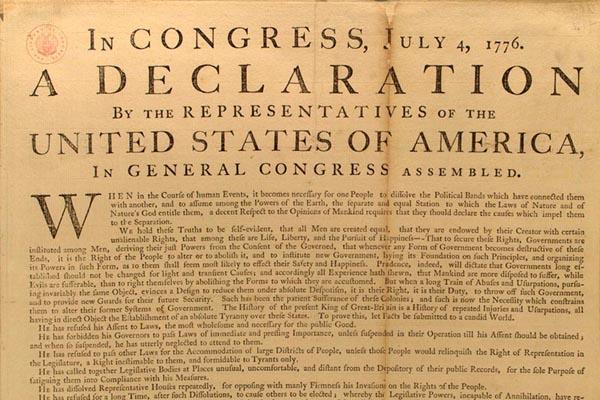
In Forbes Magazine, Carmine Gallo makes a strong case for staying close to the "Rule of 3" when presenting ideas. Gallo begins by quoting the U.S. Declaration of Independence, which celebrates three inalienable rights:

-Life
-Liberty
-And the pursuit of happiness

Image result for images declaration of independence
Public Domain
He reminds us that those three powerful ideas inspired France to arrange its freedoms into three groups: "Liberty, equality, and fraternity."

Gallo says Apple co-founder, Steve Jobs, loved threes. Macintosh, iPod, and iPhone. The iPad came in three models:  16, 32, and 64 GB of flash storage. The iPad was "thinner, lighter, and faster than the original."  

While our April Strategist Post reported that attention spans have much to do with the person and context, using only three pieces of information (or words) increases the likelihood of some retention on the listener's part.

Maybe that's why preachers are trained to prepare three-point sermons.  

The longer the list, the more challenging the recall.  

You get the idea.

o  Five persuasive words

Gregory Ciotti is a gifted copywriter. I came across his "copy blogger" website and found his wordsmithing approach to persuasion intriguing.   

Here are his five persuasive words:  

1. You     

Using someone's name is even better.

2. Free   

But used only when it makes sense and only in the proper context.

3. Because   

People simply like to have a reason for doing what they do (Dr. Cialdini). 

4. Instantly  

We wanted things yesterday. This idea is showing up everywhere.

5. New

New fixes to old problems. New features and improvements. New designs.

o The 3-6-9 principle

Something worth considering is the 3-6-9 principle from Robert Dilenschneider.  Mr. Dilenschneider is a professional acquaintance who, fifteen years ago, conducted a seminar for a board retreat that featured this multiplication formula:  

3x:   Number of times it takes to make an impression.

6x:   Number of times it takes to be reached.

9x:   Number of times it takes to be believed.  

Image result for images for the word repetition
(C) dreamsOin1digital
This reinforcing matrix is a reminder that one time is not enough when attempting to deliver persuasive-type messages.    

o  Who you are

Content and context are vital to persuading--including the right platforms. But nothing is as important as your own character.  

A lot of what it takes to get and hold someone's attention, to be persuasive, rests with the individual doing the persuading. So Aristotle reminded us of a robust causal relationship between character and convincing others.  

The toolbox may help, but successful persuasion is up to you.

Strategist.com

(C) Bredholt & Co.


April 01, 2018

Partial Attention Syndrome

"Marketing is a contest for people's attention."

--Seth Godin 

In this post on persuasion, we look at the necessity of having someone's attention since you can't persuade without it.

With intelligent technologies consuming more of our time, getting and holding attention is difficult. Consulting firm Activate, Inc. estimates people spend 12 hours a day on average consuming tech and media, including moments when they're multitasking.  

While attention is a precondition of persuasion, it's not the only one. More important is having a proposition of interest to the audience. Combining attention with a legitimate message gives a speaker, sales representative, teacher, or parent at least a chance to persuade.

Overtaken by short-lived images in movies and commercials and long-winded talks with no substance, we're drawn to what stands. When creating content, simplicity and truthfulness are attractive qualities to receptive minds.

A new kind of addiction

Technology-enabled addiction to information was given a name by Linda Stone, a former Apple and Microsoft executive who in 1998 referred to this condition as continuous partial attention.  

Ms. Stone observed that drinking from a fire hose of information created "an artificial sense of constant crisis." She noted that since these crises are generally someplace else, "We are everywhere except where we actually are physical."  

Image result for images of checking  mobile phones
(C) Broadly Vice
What does it mean when leadership itself is afflicted with continuous partial attention? How does one think deeply and act clearly without having moments where the mind is free of addictive behavior?  

Constantly checking one's mobile devices during essential meetings isn't a safe way to steer a corporation.   

Preoccupied pilots

On October 21, 2009, distracted by their duties, two Northwest Airlines pilots overshot their destination by 150 miles on a flight from San Diego, California, to Minneapolis, Minnesota. As a result, Northwest flight 188 was out of radio contact with flight controllers for 77 minutes that day.

The flight landed safely at the Minneapolis-St. Paul Airport with 144 passengers and three flight attendants. But not before causing great concern in the air and ground.

Image result for image airbus A 320 northwest airlines
(C) Airliners Gallery
Captain Timothy Cheney and First Officer Richard Cole, both with spotless records, testified that they were "glued to their laptops, puzzling over a new flight scheduling system." Yet, what should have taken ten minutes extended so long that U.S. controllers asked them to execute "confidence turns" to prove that the pilots, not hijackers, were in charge of the plane.

An FAA investigation later stated that the pilots suffered from a loss of "situational awareness," which contributed to the overflight and co-pilot Cole setting the radio frequency to Winnipeg, Manitoba, Canada, instead of Minneapolis.   

The Airbus A-320 has a mechanism for sending text messages to planes in flight. But, unfortunately, there's no chime or aural alarm. As a result, these pilots were not aware of communication initiated by the Federal Aviation Administration to reach them.

Distractions are ever-present and potentially fatal.

The goldfish myth

Do you recall reading about a study by Microsoft Canada showing the human attention span dwindling from 12 seconds in 2000 to eight seconds in 2013? That finding was compared to a goldfish's average attention span, which was thought to be nine seconds.  

Image result for images of goldfish
(C) Fish Keeping Magazine
This information was reported by TIME Magazine, USA Today, and the New York Times. In addition, reference was made to the Microsoft study in a Strategist Post. 

The Consumer Insights team at Microsoft Canada surveyed 2,000 Canadians and studied the brain activity of 112 individuals as they went through daily routines. The idea of a shortened human attention span, popularized by the report, does not come from Microsoft research. That goldfish tidbit was actually sourced by Statistic Brain. Upon further examination, the finding does not hold up well under scrutiny.  

Dr. Gemma Briggs, a psychology lecturer at Open University, told Simon Maybin of BBC World Service that when it comes to listening, "It's very much task-dependent. How much attention we apply to a task will vary depending on what the task demand is ... and what the individual brings to that situation," concludes Dr. Briggs.

After studying fish behavior for almost half a century, Professor Felicity Huntingford stated that goldfish don't have short attention spans or memories, and there's no reliable evidence that human spans are shrinking.  
  
Chance favors preparation

Dr. Robert Cialdini offers this advice ...

"The most important part of any argument is preparing the audience to be convinced by it."

Dr. Cialdini's research shows that the secret to persuasion doesn't lie in the message itself but in the moment before the message is delivered.    

Therefore when it comes to changing minds or behavior, and regardless of the delivery platform, it's the speaker's responsibility to gain attention, not the audience, to automatically give it.

Related image
(C) dixit.es
If you're trying to persuade others to do something out of the ordinary, think about preparing the audience to capture attention, create empathy, meet expectations, and motivate a response.   

In a partial attention environment, the successful persuader understands its preparation above all. 
           

Strategist.com

(C) Bredholt & Co.


March 01, 2018

A Short Course in Persuasion

"There is no expedient to which a person will not resort to avoid the real labor of thinking."

--Dr. Robert Cialdini


In the first of a series of posts on the topic of "persuasion," we look at Dr. Cialdini's ideas and research findings.  They're the result of a lifetime of study while serving as professor of psychology and marketing at Arizona State University, and as visiting professor at Stanford University. 

Quotable quotes

Recently Farnam Street newsletter offered quotes from Dr. Cialdini on persuasion. Here are four that caught our attention ...

"We seem to assume that if a lot of people are doing the same thing, they must know something we don't."

"Since 95 percent of the people are imitators and only 5 percent are initiators, people are persuaded more by the actions of others than by any proof we can offer."

"In part, the answer involves an essential but poorly appreciated tenet of all communication: what we present first changes the way people experience what we present next."

"As the stimuli saturating our lives continue to grow more intricate and variable, we will have to depend increasingly on our shortcuts to handle them all."

A path to successful persuasion

Here are Dr. Cialdini's six "Principles of Persuasion:"

No. 1: Reciprocity


Simply put, people are obliged to give back to others the form of a behavior, gift, or service that they have received first.

No. 2: Scarcity

People want more of those things they can have less of.

No. 3: Authority

This is the idea that people follow the lead of credible, knowledgeable experts.

No. 4: Consistency

People like to be consistent with the things they have previously said or done.

No. 5: Liking

People prefer to say "yes" to those that they like.

No. 6: Consensus

Especially when they are uncertain, people will look to the actions and behaviors of others to determine their own.

Learn more about the six principles.

His book, "Influence, The Psychology of Persuasion," which has sold more than three million copies, may be purchased here.


www.strategist.com

(C) Bredholt & Co.


February 01, 2018

Stratagem Horribilis

"Effective strategists are not people who abstract themselves from the daily detail but quite the opposite: they are the ones who immerse themselves in it, while being able to abstract the strategic messages from it."

--Henry Mintzberg
The Battle of Passchendaele

The disturbance at the infamous World War I battle of Passchendaele (Third Battle of Ypres), conducted between July and November 1917, was not the wind but the rain, Northeastern France's heaviest rainfall in 30 years. It was sunny when the plans were made at corps headquarters; as a result, 275,000 British troops fell. 1

According to historians, the goal of the British commander, Sir Douglas Haig, was to destroy German submarine bases on Belgium's northeast coast. Going through British-held Ypres was the chosen route. 

Image result for pictures of sir douglas haig
Sir Douglas Haig, Commander in Chief, British Armies, World War I
(C) The Long, Long Trail UK

The critics argued that the planning of Passchendaele in the fields of Flanders was carried out in almost total ignorance of the conditions under which the battle had to be fought. No senior officer from the Operations Branch of the General Headquarters, it was claimed, ever set foot (or eyes) on the Passchendaele battlefield during the four months that the battle was in progress. 2

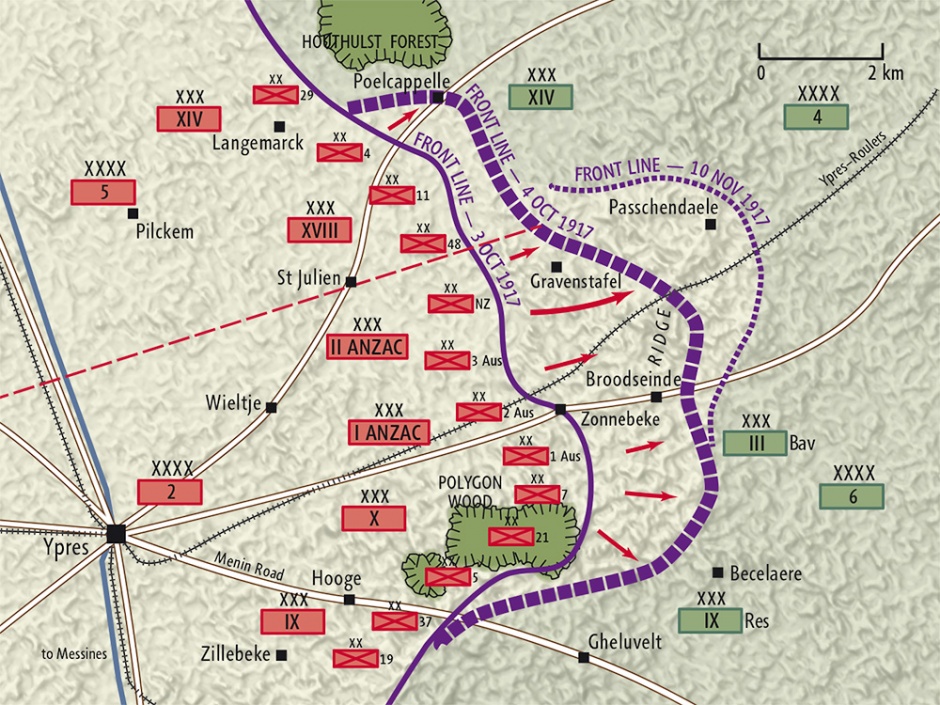
Image result for battle of passchendaele map
Battle of Passchendaele Map
(C) NZ History

Daily reports on the condition of the battlefield were first ignored, then ordered discontinued. Only after the battle did the Army chief of staff learn that he had been directing men to advance through a sea of mud. 3

The "great plan" was implemented despite the effect of the steady, drenching rain on the battlefield--despite the fact that the guns clogged, that soldiers carrying heavy ammunition slipped off their paths into muddy shell holes and drowned, that the guns could not be moved forward and the wounded could not be brought backward. 4

The book "A Short History of World War I" says: "Still the attack went on; they slept between sheets at corps headquarters and lamented that the infantry did not show more offensive spirit." 

"A staff officer ... came up to see the battlefield after it was all quiet again. He gazed out over the sea of mud, then said half to himself, "My God, did we send men to advance in that?" after which he broke down weeping, and his escort led him away."5   

Canadians to the Front 

A Canadian Corps of 100,000 strong was ordered to the Passchendaele front, east of Ypres, in mid-October 1917 to relieve New Zealand and Australian troops.

Sir Arthur Currie, commander of the Canadian Corps, objected to the battle, fearing a significant number of soldiers would lose their lives due to the physical conditions of the terrain. But, under
 orders, Currie began getting his troops ready to fight, knowing deliberate preparations, primarily for artillery and engineers, were the key to advancing over the damaged landscape.  

Nearly 16,000 Canadian soldiers fell in battle between mid-October and mid-November while capturing the targeted ridge. 6

Passchendaele Battle Summary 

105:   Number of days battle lasted

275,000:  Casualties under British command (average 2,100 per day)

220,000:  Casualties under German command

90,000:  Number of bodies never identified (42,000 not recovered)

4.25 million:  Estimated number of shells fired 

Source: Casualties and Munitions 

__________________


In Flanders Fields

In Flanders fields, the poppies blow
Between the crosses, row on row,
That mark our place; and in the sky
The larks, still bravely singing, fly
Scarce heard amid the guns below.

We are the Dead. Short days ago
We lived, felt dawn, saw sunset glow,
Loved and were loved, and now we lie
In Flanders fields.

Take up our quarrel with the foe:
To you, from failing hands, we throw
The torch; be yours to hold it high!
If ye break faith with us who die
We shall not sleep, though poppies grow
In Flanders fields.

--Canadian Lieutenant-Colonel John McCrae


Sources:  
1. Henry Mintzberg 
2. M. D. Feld
3. Ibid
4. J. L. Stokesbury
5. Ibid
6. Canadian Museum of War 


Strategist.com

(C) Bredholt & Co.