Showing posts with label Steve Jobs. Show all posts

September 01, 2026

Pairing Artificial Intelligence With the Liberal Arts

Steve Jobs. CNBC

"It's technology married with liberal arts, married with the humanities, that yields the results that make our hearts sing."

 —Steve Jobs, Apple Co-Founder

News about artificial intelligence (AI) and data centers is ever-present. Daily headlines and stories about OpenAI (ChatGPT), Anthropic (Claude), Nvidia, and others leave little time for the public and private sectors to understand what's really going on. 

That may explain the one-year moratoriums on data center land sales and construction in the U.S. and other countries. A Gallup Poll found that more than seven in 10 voters, including large majorities of both Democrats and Republicans, said they wanted no such facility built near their homes.

Meanwhile, one observer said, "The American economy is hoping the boom doesn't go bust." 

A cautionary transformation

In healthcare, artificial intelligence is revolutionizing diagnostic accuracy. It's fundamentally transforming software programming. The publishing industry is trying to balance creativity and ethical concerns. Amid a shrinking labor supply and growing AI-assisted cheating, companies are changing remote job interviews to ensure candidates are who they say they are. 

The Wall Street Journal recently reported that Kellanova (formerly a part of the Kellogg Company) and Siemens spent four years using AI and digital twin technology (a live virtual copy of a real physical thing, place, or process) to make the perfect, uniform Pringles potato chip. This innovation comes as consumers eat fewer chips because of price increases and health concerns. 

More than 40 million people globally use ChatGPT for health advice at least once every day, according to the chatbot's maker, OpenAI, mostly to check or explore symptoms. They also ask about everyday problem-solving and personal advice. Those chats aren't completely private, and deleting them doesn't always mean they're gone.

In August of this year, The Washington Post reported a dozen examples of chatbot conversations being swept into criminal and civil proceedings. 

AI also has an expanding role in modern warfare.

What should be concerning about artificial intelligence? 

In the immediate term, the literature points to a real-world loss of human accountability, transparency, and control over critical decisions. 

"I don't worry about some dystopian future; I worry about the reality we have right now, and how we integrate the amazing possibilities of artificial intelligence into human-centered systems," says Dylan Losey, Assistant Professor of Mechanical Engineering at Virginia Tech.

More than technology

What exactly is artificial intelligence?

Steve Wozniak, a co-founder of Apple, put it simply: AI is an attempt to imitate the brain. Note that he doesn't say the "mind," although that could be next. 

How that imitation happens through large language models (LLMs) is another story, and others tell it better. 

Our interest is in humanity and the potentially beneficial relationship between AI and the liberal arts. In an academic setting, Adam Grant of the University of Pennsylvania says students need an ethical education to understand integrity, a vital contribution the liberal arts can make to technology. 

A great combination

In a 1996 interview with NPR's Terry Gross, Steve Jobs explained that combining technical and engineering skills with artistic disciplines (such as design, philosophy, and poetry) created products that made the "heart sing." 

Those intersections also shed light on Tim Cook's executive leadership, which has been highly successful in carrying forward Steve Jobs' innovative ideas and helping Apple thrive. Cook retires this month after 15 years as CEO of the world's second-largest company with a market capitalization of nearly $5 trillion. 

Jobs' belief was that computer science is a "Liberal Art," a tool that everyone understands and uses in their daily lives. He often said technology needs a human-centered perspective to be truly useful and appealing. 

In an essay cautioning against the neglect of humanities, Greg Dickens writes in Medium, "But if you make time for the liberal arts, not only will you become a more interesting person, you can find that little something that will differentiate you from everyone else."

The Guardian newspaper once described Apple's distinction as "an obsessive, uncompromising focus on eliminating the non-essential when it comes to its products." 

The role of soft skills

In 2017, Dr. David Deming, Dean of Harvard College, published a report highlighting the importance of soft skills alongside technology. Dr. Deming's thesis shows why it pays to be different in the workplace. 

"With the help of AI, white-collar workers can generate far more memos or strategy options than in the past and churn out more productive prototypes or software features. But some executive still has to decide which option to greenlight," writes Norm Scheiber in The New York Times.

"As AI makes production of knowledge work more and more efficient, the job of presenting, debating, lobbying, arm-twisting, reassuring or just plain selling the work appears to be rising in importance," Scheiber adds.

Dr. Deming says that these skills were always important. "But as the information landscape becomes more saturated, the ability to tell a story out of it — to take a ton of text and turn it into something people want — is more valuable." 

As automation heightens the importance of personal interaction, soft skills matter, but they're not enough. Dr. Deming concludes that the people who fared best tended to combine social skills with substantive knowledge.

Counsel from credible sources

In an article entitled "What AI Bosses Advise Their Kids About Jobs," Personal Journal writer Lauren Weber interviewed individuals heavily involved with artificial intelligence.*

Here's a summary of advice to their children (ranging in ages 4 to 26) about what to pay attention to as they consider the future of careers in an AI-driven world: 

Critical thinking, an essential life skill; adaptability; ethics (human judgment); mathematics; ability to relate, empathize, and be around other humans; communication; and how kind you are.  

A liberal arts education matters more than ever, these experts suggested.

The Journal just reported that Ernst & Young's U.S. Division is giving out $100 million in bonuses and rewards to recognize employees who show human skills like adaptability, innovation, and judgment, as well as experimentation with AI. 

Versatility counts

After warning that artificial intelligence would eliminate many white-collar and entry-level jobs, OpenAI CEO Sam Altman apologized, saying, "I'm delighted to be wrong about that." 

It's too early to know for sure, but the threat is there. Current workforce reductions stem from financial and structural problems in businesses and nonprofits, while the blame is shifted to AI.

Whatever jobs AI takes, it will create new ones that didn't exist a few years ago. Breakthrough technology functions that way. Who benefits? MIT labor economist David Autor says it's college graduates under 30, often in urban settings. Those who can learn new things gain specialized knowledge and expertise, increasing their worth.

U.S. Labor Department studies show substantially fewer people entering the workforce between now and 2030, so those who want work will, for the most part, have it. However, those positions may not always be in a graduate's field of study.  

LinkedIn data shared exclusively with Forbes magazine shows that the key to young professionals successfully navigating today's uneven job market is whether their degree is adaptable enough to land a job in several different industries. 

The top five most versatile college majors, where 2022 to 2024 graduates landed jobs farther afield from their majors, are English, Visual and Performing Arts, Communication and Journalism, Business and Marketing, and Computer and Information Sciences. 

Walking in wisdom

At some point, college graduates and those in skilled trades learn that they too bear responsibility for making (and keeping) themselves desirable and employable. 

However, it's an invaluable gift when someone who has practiced takes a special interest in our lives. They support development by pointing toward self-awareness, strong moral character, and trust. Improve performance with timely advice. They are also good listeners. 

A universal truth: "When the student is ready to learn, the right teacher comes along."

Providing that kind of assistance to young adults, or anyone, is a personal endeavor, though it likely utilizes technology in some form.  

Which, in the spirit of Steve Jobs' original thought of combining technical skills with artistic disciplines, should make our hearts sing. 


*Caroline Hanke, global head of organizational growth and health at SAP; Ethan Mollick, professor at the University of Pennsylvania's Wharton School and co-author of Co-Intelligence: Living and Working with AI; Jaime Teevan, chief scientist and technical fellow, Microsoft, and trustee, Yale University; Daniela Amodei, President and co-founder of Anthropic.

Strategist.com

©  Bredholt & Co.


April 01, 2021

The Power of a Predictable Leader

"Nor yet be overeager in pursuit of any thing; for the mercurial often happen to leave judgment behind them, and sometimes make work for repentance."

--William Penn

In a recent survey of over 1,000 executives, more than half--in different industries--said their roles had changed due to the pandemic. Some 30 percent said their jobs have changed permanently, according to Chicago-based WittKieffer, who sponsored the research.  

The study raises this implication--many leaders are being asked to do work they weren't previously trained or prepared to do. "While some are excelling in a new environment, other executives are struggling to find their place during the pandemic," the report stated.

That analysis describes how an outside force like COVID-19 causes disruptive change. 

What are organizations doing to themselves?

Destabilizing influences

Even as the economy rebounds, it's hard to blame any remaining woes on infectious disease.    

Professor Howard Stevenson, who teaches at Harvard University, says that companies were destroying necessary predictability leading up to 2020.  

"The practices that leaders are adopting to make their organizations more competitive are ignoring the human need for predictability," Stevenson observed. "Corporations must recognize the paradox that many management tools, in fact, destroy what holds the organization together," he concluded.  

(C) The Telegraph

That need for predictability among associates is not a need for guarantee--it's a need for clarity and consistency.

Professor Stevenson points to the following causes of damage to employee morale and cultural glue:

--Reengineering throws out all the old procedures and rules of thumb by which an organization has operated.

--Continuous improvement programs promise only that an organization's rules will continue to change.

--Matrix management requires that two (or more) managers, who need not agree with each other, judge employees' work and determine their future in the company.

--Rightsizing sheds people, often regardless of their individual skills or performance.

In the age of Zoom Professor Stevenson adds that "nowhere is the notion of predictability more threatened than in a virtual organization which is not much of an organization at all."

Unpredictable

Mercurial describes someone whose mood or behavior is changeable and unpredictable; or who is clever, lively, and quick. It's out of that temperament where management fads often originate. Compulsive behavior is the opposite of being predictable.   

Apple's Steve Jobs had a mercurial style. His behavior included rapid and unpredictable change but also qualities of eloquence and ingenuity.  

The real world is not straightforward and people are complicated. For example, working for an impulsive boss, which can be a difficult experience, means you must adapt or move on. 

Predictable 

British author, Roderic Yapp, writes that if you're working with people as part of a team, you want to be predictable. "You want to make it easy for them to meet your expectations because unpredictability is a nightmare for people trying to manage upwards," he notes.

How does one be more predictable? He offers the following advice:

1. Deepen the relationships you have with your people. 

How can you motivate someone and improve their performance if you know nothing about them? Build a deeper relationship with the person by asking them about their personal history. What is important to them? What drives and motivates them? What do they want out of life, and how can you support that aspiration. 

In the exchanges, give them a roadmap to you.

2. Remove emotion from the equation.

Do you purposefully act in a chosen and deliberate manner, or are you simply reacting? The two are very different. Reactions happen quickly. 

The most common is when mistakes are made, tempers get lost, and voices get raised. These behaviors lead to a climate of fear and, at best, compliance. Impertinent conduct undermines open, honest conversation and challenge. It causes those around you unnecessary stress. An unbecoming habit can result in the best people leaving. 

Acting deliberately is a choice. It involves being aware of your behavior and its impact on other people. 

Gaining composure

We're all wired differently. However, remaining consistent and undisturbed inside that unique wiring is not always easy. It comes naturally to some, like doctors and airline pilots. But for others, it requires practice to get there. 

While leopards can't change their spots and tigers their stripes, we're not as fixed in our frame of mind as some might think. Maturing in attitude and behavior is a big part of professional development. In addition, personal growth leads to wisdom which is a desirable trait and an overlooked strength.  

Ultimately, the right kind of power and predictability accrues to a leader with self-control. In turn, that composure gives confidence to others when they need it the most.    


Strategist.com

© Bredholt & Co.


May 01, 2018

The Persuader's Tool Box

"Character may almost be called the most effective means of persuasion."

--Aristotle

Creating a persuader's toolbox is one way of addressing a variety of leadership styles, settings, and topics. Doing so reminds me of my dad's toolboxes filled with hammers, pliers, screwdrivers, wrenches, and tape measures.       

A tool that's often overlooked is a question. Whether it's a formal presentation or conversation, what will make the listener want to agree with you? And in your situation, what's the best way to make that happen?

In addition to a legitimate proposition and asking the right questions, what else should be in the persuader's toolbox?

o  A persuasive theory

A persuasive theory seeks a favorable response from the audience. It begins with "why."    

Carefully chosen language becomes a motivating argument that causes others to want to decide in favor of (fill in the blank). The theory, or reason to believe you, should be communicated succinctly in a few sentences. Offering too much information is likely to overwhelm an audience.  

Image result for images for "word"
(C) Oxford Dictionary
Think about how preparation in the early stages might improve the chances for success. The presenter's job, not the audience, is to sort through information in advance.

As Robert Louis Stevenson once said, "All speech is a dead language until it finds a willing hearer." 

o  Stories and themes

We were asked to arrange a mock jury. The law firm and jury consultant put the package together. After that, recruiting participants was up to us. That engagement prompted a closer examination of how lawyers try to persuade juries. 

What did we learn?

Experienced courtroom practitioners attempt to know their juries (or judges) while rolling out what they hope is a persuasive theory of the case (See United States Government v. Microsoft Corp., 2001)
Image result for images for microsoft logo
(C) Microsoft
"A skillful trial attorney knows how important it is to join a series of facts with a unifying theme as jurors deliberate and rely on themes to sort out the evidence. If attorneys don't provide the theme, jurors will do it for themselves," according to University of Washington law professor William S. Bailey. 

Employees, customers, voters, and even congregational members, are juries of their own making and require context by which to make decisions.  

In his autobiography, prominent litigation attorney David Boies writes: "There is much to be said for staying on message, but when you seek to persuade, you must address the concerns of the people you are trying to convince."  

Image result for images for coca cola
(C) Coca-Cola
What's the difference between a story (Coca-Cola's history) and a theme ("More Than a Soda Company")?  

"Stories are about the growth of character. They provide the mythic and emotional skeleton. Themes are the development of ideas and conceptual coherence," says Tristine Rainer. Powerful themes are those that resonate with ordinary human beings. A good theme acts like glue, enabling a few details to stick.    

Ask yourself--do you need a story or theme to persuade? Likely both.   

o  Rule of 3  

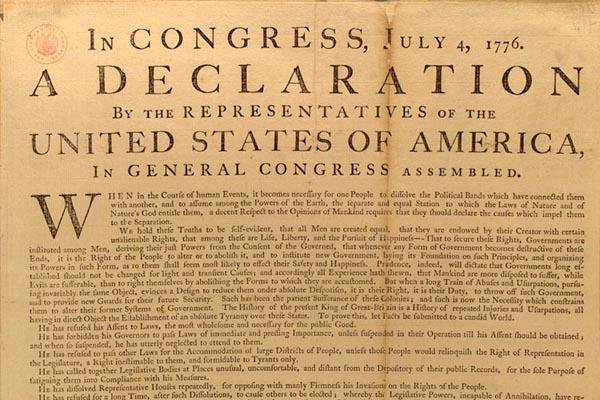
In Forbes Magazine, Carmine Gallo makes a strong case for staying close to the "Rule of 3" when presenting ideas. Gallo begins by quoting the U.S. Declaration of Independence, which celebrates three inalienable rights:

-Life
-Liberty
-And the pursuit of happiness

Image result for images declaration of independence
Public Domain
He reminds us that those three powerful ideas inspired France to arrange its freedoms into three groups: "Liberty, equality, and fraternity."

Gallo says Apple co-founder, Steve Jobs, loved threes. Macintosh, iPod, and iPhone. The iPad came in three models:  16, 32, and 64 GB of flash storage. The iPad was "thinner, lighter, and faster than the original."  

While our April Strategist Post reported that attention spans have much to do with the person and context, using only three pieces of information (or words) increases the likelihood of some retention on the listener's part.

Maybe that's why preachers are trained to prepare three-point sermons.  

The longer the list, the more challenging the recall.  

You get the idea.

o  Five persuasive words

Gregory Ciotti is a gifted copywriter. I came across his "copy blogger" website and found his wordsmithing approach to persuasion intriguing.   

Here are his five persuasive words:  

1. You     

Using someone's name is even better.

2. Free   

But used only when it makes sense and only in the proper context.

3. Because   

People simply like to have a reason for doing what they do (Dr. Cialdini). 

4. Instantly  

We wanted things yesterday. This idea is showing up everywhere.

5. New

New fixes to old problems. New features and improvements. New designs.

o The 3-6-9 principle

Something worth considering is the 3-6-9 principle from Robert Dilenschneider.  Mr. Dilenschneider is a professional acquaintance who, fifteen years ago, conducted a seminar for a board retreat that featured this multiplication formula:  

3x:   Number of times it takes to make an impression.

6x:   Number of times it takes to be reached.

9x:   Number of times it takes to be believed.  

Image result for images for the word repetition
(C) dreamsOin1digital
This reinforcing matrix is a reminder that one time is not enough when attempting to deliver persuasive-type messages.    

o  Who you are

Content and context are vital to persuading--including the right platforms. But nothing is as important as your own character.  

A lot of what it takes to get and hold someone's attention, to be persuasive, rests with the individual doing the persuading. So Aristotle reminded us of a robust causal relationship between character and convincing others.  

The toolbox may help, but successful persuasion is up to you.

Strategist.com

(C) Bredholt & Co.


May 01, 2015

Help Wanted

“Let us realize that: the privilege to work is a gift, the power to work is a blessing, and the love of work is a success!”

--David O. McKay

With college commencements getting underway here’s some news for graduates (and parents) that they may or may not want to hear—it doesn’t much matter where you went to school.  What matters is how you go, so says Purdue University President Mitch Daniels.

The former Indiana governor and onetime director of the Office of Management and Budget (OMB) in Washington D.C., is basing this "how" idea on the results of a Gallup-Purdue Index, a national survey of 30,000 college graduates released for the first time in 2014. As reported in The Wall Street Journal, the survey is an attempt at quantifying not only what a graduate earns but also how well they are navigating adult life.

According to the study, only 39% of college graduates report feeling engaged with their work. In that group as many come from the top-100 schools as don’t. The three most important contributions that college makes to a sense of workplace achievement after graduation:

1.    Having one professor who made you excited about learning

2.    Feeling as though the teachers cared about you

3.    Working with a mentor

Graduates who marked those boxes on the survey were more than twice as likely to sense they are flourishing at work.

The Gallup-Purdue Index shows that only 14% of those surveyed said they had attained all three in college.

Other positive factors in the study from undergraduate life:

·       Working on a long-term project

·       Having an internship

·       Participating in extra-curricular activities

The point: Where graduates went to college barely registered as a predictor of job satisfaction according to the Index.

The benefits of college

While cost is a major consideration, and not everyone must go through a bachelor's degree program to succeed in life, the pay gap between college graduates and everyone else is near a record high. Among millennials, ages 25-32, earnings for college degree holders are $17,500 greater than those with high school diplomas only. This is according to the Pew Research Center.

In addition to total earnings over a lifetime, the short-term benefit of completing a college degree is employment. 

Unemployment rate by education level, adults ages 25 to 34:

No H.S. diploma 13.8
H.S. diploma, no college 8.4
In some colleges, no degree 7.2
Associate degree only 5.8 
Bachelor's only 2.0
Master's  2.2
Advance professional 4.4
Doctoral 1.1  
 
Source: U. S. Bureau of Labor Statistics, March 2015

Universal qualities

A great deal of attention is paid to technology in a 21st-century economy, and rightfully so. Yet technology is a sword that cuts both ways--it's a net job creator while removing routine work.

Since 2008, 44% of U.S. firms have reduced their headcounts in part because of automation.   Nearly 50% of U.S. jobs are at high risk of becoming automated in the next 20 years according to Oxford University research published in TIME Magazine.

How does anyone prepare for such an unstable work environment?  Keep learning; remain flexible, and avoid routine work. As reported by the U.S. Bureau of Labor Statistics, people now in their 50s have changed jobs 11.3 times on average over their working lives.  New jobs require new skills.

However, in marketing to prospective students and parents may be colleges and universities are overlooking universal qualities and skills that employers seek when hiring--some of which can be honed while in the hallowed halls of ivy.   Or in certain cases, online.

The time to start developing the more sought-after hiring skills is when traditional students are in their college years. This is a period that allows for trial and error more so than a first or second career job where grading is often on a much harsher scale.

The well-rounded person

What are the attractive skills a person should consider pursuing that are just as integral to the education, training, and experience for specific kinds of jobs? The National Association of Colleges and Employers asked employers responding to their Job Outlook (2013) what skills they prioritize when hiring. Here are the top 10: 

1.    Ability to verbally communicate with persons inside and outside the organization

2.    Ability to work in a team structure

3.    Ability to make decisions and solve problems

4.    Ability to plan, organize, and prioritize work

5.    Ability to obtain and process information

6.    Ability to analyze quantitative data

7.    Technical knowledge related to the job

8.    Proficiency with computer software programs

9.    Ability to create and/or edit written reports

10. Ability to sell or influence others

Note that soft and hard skills are evenly divided on the list. 

Orientations more than commencements

Higher education might want to focus on four areas that could make a significant difference in the college experience: build awareness for universal qualities in freshman orientations; enlist faculty to make application within a chosen field of study; place the qualities inside all degree programs, especially science, technology, engineering and math (STEM); and link the qualities with internships. 

Steve Jobs, a college dropout, often described Apple as “the intersection of technology and liberal arts.” That business model, a philosophical legacy from Jobs himself, is currently sitting on $194 billion in cash and long-term investments. 

Once inside an organization—high tech, banking, nonprofit—all who want to be engaged and contribute have to eventually figure out how to work with others to accomplish common goals.  This is where cultural fit comes into play. 

To achieve a higher level of performance early in a career it would be better to know what the hiring skills are at the outset of college life than learn about them for the first time at commencement. Or, during a job interview.  

Final thoughts 

In looking to the future, and based on the research, how can colleges identify, hire and reward more professors who are capable of helping students “light the wick” of learning?   

According to the Gallup-Purdue Index, teachers with a gift to inspire contribute much to how we learn, to our character-building and workplace achievement. That has proven to be my experience, for which I am grateful.

Strategist.com

© Bredholt & Co.


June 01, 2013

Responding to Surprise

Milo Jones and Philippe Silberzahn
Guest Contributors
                         
Despite tremendous developments in business strategy over the last fifty years, businesses and governments keep being disrupted by events that they might have seen coming, but didn’t. In other words, they get surprised… and not in a happy, surprise party kind of way. Think of 9/11, the Arab spring, Fukushima, or the launch of the iPhone for Nokia.
 
Such events often have consequences far beyond their immediate environment that make many firms suffer, and require a response that isn’t in anyone’s existing playbook.  The late Steve Jobs – no slouch when dealing with disruption in the marketplace – once replied that his strategy was to “wait for the next big thing.”
 
Should you be doing the same?
 
When confronted by a surprise – however freakish it may be – there is a tendency to rush to action. It’s natural to ask: “What should we do?!”
 
US President Jimmy Carter, for example, was recalled from vacation in the summer of 1979 by the urgent and disturbing news that an elite Soviet commando unit had been spotted in Cuba. What were the Soviets up to? Did this mean a new Cuban Missile-style crisis?
 
US armed forces were put on alert, and Defense Department experts assembled in a War room… until someone reminded the participants that the Soviet commando brigade had pretty much always been there. Indeed, their presence in Cuba had been agreed to by JFK in 1962. In short, a problem did not exist, and the rush to “do something” by someone learning a fact for the first time manufactured a crisis out of thin air.
 
A puzzled Russian ambassador asked his US counterpart: “How am I supposed to explain this to my government?”
 
Nobody wants to be like the (still-unnamed) guy in the White House who acts before thinking, but how specifically should you act in the face of a surprising fact or shocking event? We suggest three simple questions to be your guide.
 
#1 What’s going on?
 
There will always be voices saying “Act, do something, respond”, but nine out of ten times, it pays to explicitly ask the question What’s going on?” and even perform some rapid analysis before doing anything else. In other words, when surprises happen, take a moment to untangle what you actually know from what people are assuming and from what is still unknown.
 
Better still, poll a few other executives for their take on what is going on. Are their assumptions the same as yours? Do they agree on what is still unknown? Do they know someone who could help fill in the gaps?
 
If there really is a crisis, and you’re not facing a Carter-like moment, getting such basic agreed facts written up on a whiteboard in a ’war room’ is the beginning of effective crisis management. If the surprise involves a natural disaster or other crisis covered by TV, we recommend that you keep the TV on, but turn the sound off: news channels will have whoever is to hand (or good-looking and was free to get on a plane) blathering on about this or that rumor, or doing endless recaps of the obvious (preferably with an emotional, ”human-interest” spin).
 
If you’re after information about what’s really going on however, just watch the scene and make logical deductions when the cameras pan out. Is smoke rising from the ruins? Can you see panicked crowds, or do the police look like they’re maintaining control? In other words, interrogate the images to help figure out the first key question “What’s going on?”
 
#2 What does it mean?
 
Once you have some clarity about what you know (and what you don’t know), you can ask the next question: “What does it mean?” Specifically, you can ask “What does it mean for us?” In other words, as the outlines of a surprising event come into focus, you can begin to think through the implications of the event for your firm.
 
Typically, people employ two mental tools to answer this question.  Whether they know it or not, the first tool that people instinctively use is an event cascade. An event cascade is simply a chain of cause and effect, or “If this, then that” reasoning. If there has been a volcanic eruption in Iceland, then the ash may disrupt air travel; if air travel is disrupted, airline profits will suffer, logistics chains may break or slow down, etc.
 
Typically – and again, whether they know it or not – the second tool people use to understand the meaning of a new situation is analogies. Say your industry is crippled by a disruption caused by the Internet. People will often mention a similar industry having undergone a comparable disruption, and then point out the similarities and draw lessons.
 
Here, we recommend that you be careful – analogies can be seductive. You should ask not only what is similar about your situation, but also what is different. Looking for similarities and differences across several analogous situations should tell you a lot about what the present situation means for you.
 
#3 What should we do?
 
Then, and only then, should you ask our third key question following a surprise: “What should we do?” Here, we recommend a couple of techniques to make better decisions. First, like a good chess player, “Think several moves ahead”. Draw on event cascades again and think move/counter move.
 
Second, look at your firm from the outside, and with perspective. Keep in mind President Kennedy’s benchmark during the Cuba missile crisis of 1962: “How will the world judge our decisions when it’s over?” Finally, if you are struggling to reach a consensus about what to do (and no one has the authority or will to impose a decision), try agreeing on the mirror image of this question “What should we not do?”
 
Active discussion about what not to do frequently airs new opinions and prompts further thought about what you should do.
 
Iteration and patience
 
Finally, in thinking about what to do, remember that you always have the option to wait, the option to do nothing. There are situations where, simply put, it is better to do nothing, either because action would be counter-productive, or simply because there isn’t much to do anyway. In that case, you keep working on the first two questions; “What is going on?” and
 
“What does it mean?”
 
If that sounds like a cop out to you we refer back to the late Steve Jobs, who when asked by Professor Richard Rumelt about his strategy in 1998, simply replied: “I’ll wait for the next big thing”. When Jobs then saw it, Apple pounced and came up with the iPod.
 
But in the meantime, in the face of a lot of disruptive change and surprises in the IT industry, Jobs was thinking “What’s going on?” and “What does it mean for us?” It’s no easy task, but when faced with a surprise, real courage is sometimes best displayed not by answering the question most people are asking, “What should we do?”, but by working harder to figure out the other two questions. 
 
Reposted with permission.

The article is also on Forbes.com.
 
Strategist.com
 

© Bredholt & Co.