June 01, 2020

Disney's Dilemma

"If they don't want to come out, nobody's gonna stop 'em."

--Yogi Berra, Baseball Hall of Fame Catcher, New York Yankees (1946-1963)


The Walt Disney Co. submitted plans to reopen four U.S. theme parks in July. (Shanghai Disneyland reopened on 11 May.) However, due to the global coronavirus outbreak, Disney announced the closure of its parks on 12 March 2020.   

The request has been approved by the Orange County, Florida Economic Recovery Task Force and Mayor Jerry Demings. On 29 May, Gov. Ron DeSantis signed off on the plan. 

The reopening schedule looks like this--

--The Magic Kingdom and Animal Kingdom:  11 July

--Epcot and Hollywood Studios:  15 July



Disney Springs Complete Guide - Al's Blog
Disney Springs, Lake Buena Vista, Florida.
(C) Walt Disney Co.

Disney Springs (formerly Disney Village and Downtown Disney) reopened on 20 May with CDC guidelines for social distancing in place.   

What about Disneyland in Anaheim, California? Perhaps in June as part of California's Stage 3 road to reopening. As to resort hotels in Florida, it looks like some could reopen on 11 July, along with the Disney Vacation Club, with safety guidelines and cleaning procedures in place.  

Universal Studios will reopen on 5 June with limited capacity. SeaWorld is opening its three Orlando parks, including Discovery Cove and Aquatica, on 11 June--one month ahead of the Disney schedule.

The proposed Disney dates, if kept, will show why predicting can be a fool's errand. On 22 April, John Hodulik, managing director of research at UBS, wrote to his clients, giving a date of 1 January 2021 as "our best case" for reopening.  

Scaling down

Google returns 97 million pages when you search "scaling up" on its website. "Scaling down," like looking through the opposite end of a telescope, instantly returns 104 million pages.  

Over the last decade, "does it scale?" became a mantra for manufacturing, start-ups, high-tech, retail, and financial services. 

Now, businesses are looking to move in the opposite direction to meet reopening guidelines keeping employees and customers safe. But, as there is a cost to increasing health and safety measures, can businesses function this way and be profitable?  

Reopening

The Florida Disney parks will incorporate protocols from the county, state, and federal governments. But Disney cast members will also be learning from their sister park in China, which will have been open two months to the date when guests walk through the gates of the Magic Kingdom.  


Mickey Mouse Lovers - Home | Facebook
"Welcome back!" Mickey Mouse
(C) Walt Disney Co.

From the proposal submitted the last week of May, here's what to expect in the near term when returning to the "most magical place on earth:"

1. Disney is placing limits on attendance and controlled guest density. In addition, guests will be required to make a reservation for a particular day.

2. Events that draw big crowds--such as parades and nighttime spectaculars/fireworks--will not return until later.

3. High-touch experiences like makeovers and playgrounds will not be available from the start.

4. Character meet-and-greets will be unavailable upon reopening, but characters will still be in the park.

5. Guests ages 3 and up must wear face coverings.

6. Guests and cast members will be screened for temperatures before entering the park (as they are doing at Shanghai Disneyland). 

7. The parks are encouraging cashless transactions.

Additionally, Disney issued a COVID-19 warning on its website-- 

"By visiting Walt Disney World Resort, you voluntarily assume all risks related to exposure to COVID-19."

In its proposal, Disney did not say how much capacity will be capped at the parks as there is a corporate policy of not officially disclosing attendance figures. However, the daily total will probably be calculated on the 6' distancing guideline.   

This is a monumental task as Disney cast members will be stretched to manage the parks and monitor healthy behavior simultaneously. 

A shock to the system

Walt Disney Co., with total 2019 revenue of $69.5 billion, is an entertainment giant that one news headline recently described as a "Stricken Empire."  


The Walt Disney Company - Wikipedia
Walt Disney Co. Headquarters, Burbank, California
(C) Walt Disney Co. 

Just over 100,000 employees have been laid off. To further address costs, executive pay was cut up to 50 percent, and Disney took out a $5 billion line of credit to boost liquidity. That was in addition to the $8.25 billion the company secured in March.  

Dividends? Not at this time.

Bob Iger, executive chairman and former CEO who built this $239 billion enterprise over the past 14 years, decided in February to retire as chief executive officer.  Mr. Iger said on CNBC, "I don't want to run the company anymore."  The Board of Directors selected Bob Chapek as CEO, with Mr. Iger overseeing creative content at Disney through 2021.

Then in March 2020, the world stopped spinning.

One observer expressed it this way, "Disney's vastness has become a liability. ABC/ESPN. Disney Cruise Line. Stage shows. Disney Stores."  Launched five months ago, Disney+, with more than 50 million subscribers, is a bright spot as many adults and children are at home. 

What's Disney's dilemma?

The Wall Street Journal noted that "much of Disney's business rests on its ability to draw people into crowded spaces including theme parks, hotels, ships, sporting events, and movie theaters. Unfortunately, the return of such massive entertainment options remains questionable at any point this year."

Disney's dilemma is operating profitably, at reduced capacity, with guests' social distancing. Everything is inside a fixed-cost business model driven by increased volume, high density, and large-scale venues.  

At 1:15 p.m. on New Year's Eve 2019, Walt Disney World alerted that the Magic Kingdom, which averages 57,128 guests per day based on Theme Park Tourist website estimates, would stop accepting new guests. So when will that happen again?   

Managing risk

The future depends on factors no one controls--COVID-19 treatments and vaccines; employment levels; airlines staying in the air; and households willing to travel. Unfortunately, a survey by U.S. Travel found that only 18% of adults feel safe about flying.  

Willingness to travel more than 300 miles from home will weigh heavily on the success of reopenings at Disney and other destination resorts.   


Disney World's Magic Kingdom temporarily stops admitting new ...
The main entrance to Walt Disney World in Florida.
(C) Walt Disney Co.

According to a 2017 Money Magazine study, a family of four visiting Walt Disney World may spend about $6360 on average for flights, hotels, souvenirs, food, and park tickets during a four-night trip. 

Knowing the cost, Disney management and cast members will undoubtedly be working hard to show guests there's still "magic" in the Kingdom.   


Strategist.com

© Bredholt & Co.


May 01, 2020

A Pandemic Polarity

"We started knowing nothing. Of course, we know a lot now, but we still don't know everything."

--Dr. John Ioannidis, Stanford School of Medicine

Are the COVID-19 disease and its uneven devastation a worrying problem to be solved or a health and economic polarity to manage?   

As of 30 April 2020, there are 3.1 million COVID-19 cases worldwide and 227,638 deaths. Total cases in the U.S. are at 1.03 million and 60,967 deaths. (Johns Hopkins for Systems Science and Engineering; USA Facts)

Heading into May, U.S. unemployment claims rose to more than 30 million as the coronavirus pandemic continued taking a financial and emotional toll on American life.

The status of other diseases

Data for 2018-2019 show 35.5 million estimated cases of influenza in the U.S., with 490,561 hospitalizations and 34,157 deaths. Flu vaccines are available and highly recommended at the beginning of each season. (CDC.gov)

Nearly half the world's population lives at risk from malaria. In 2018 there were 405,000 deaths from this disease. The overwhelming majority are among children five years of age and younger. And 80-90% each year are in rural Sub-Saharan Africa. The nature of malaria, a single-cell parasite, evades the human immune system. (Center for Strategic and International Studies; CDC.gov; and WHO.int)

Smallpox is the only human infectious disease to have been eradicated. (World Health Assembly)

Problem or polarity?

In his book, "Polarity Management," Dr. Barry Johnson offers criteria that help know how to decide:

(C) Perficient, Inc.

1.  Is the difficulty ongoing?  

Problems to solve have a solution that can be considered an endpoint in a process, i.e., they are solvable.

Polarities to manage don't get "solved." They're ongoing. We're always in the process of solving them, but they don't have a clear endpoint solution. Instead, there's a never-ending shift in emphasis or focus from one pole (safety) to the other (work). "Managing" is perhaps the best way to describe this arrangement.

2. Are there two interdependent poles?

The solution to problems can stand alone. However, managing polarities requires a shift in emphasis between opposites such that neither can stand alone. It's a both/and difficulty. The pair are involved in an ongoing balancing process over an extended period. 

For example--

-Team/Individual
-Planning/Action
-Doing/Being
-Clear/Flexible
-Tradition/Change

Until there's a vaccine, the wisdom required of government and business leaders is to manage the increasing tension (polarity) of a carefully reopened economy while protecting the most vulnerable in the population. All within the framework of civil liberties.

Like Malcolm Turnbull, the former Australian prime minister, said recently, "There would be nothing more tragic than if, in our efforts to preserve our health, we were to lose our freedom." 

What are people thinking?

In addition to tracking progress on COVID-19 treatments and vaccines, it's also essential to keep up with the public opinion trendlines, as consumers are 70% of the U. S. economy.  

When does the public want businesses to reopen? As of the end of April, here are what pollsters found:

o 62% of U.S. adults are worried businesses in their community will reopen too early compared to 38% who are afraid they'll reopen too slowly.

o 52% of U.S. adults say the coronavirus outbreak is more of a health crisis, while 47% say it's more of an economic crisis. The latter group is split between Republicans at 70% and Democrats at 24%.

o 45% of U.S. adults say non-elective surgeries or doctor offices should reopen immediately in their area.

o 41% of U.S. adults expect their life will be mostly back to normal in three months.

o  7% of the public agree that sports venues, concerts, and large gatherings should reopen immediately.

o An overwhelming majority of the public isn't ready to fully reopen. More than nine in 10 U. S. adults are opposed to opening up everything. But many would be okay to see some easing, with just under half (45%) wanting to see non-elective surgeries return immediately.

o The public is more worried about the health crisis than the economic one. For example, 58% of U.S. adults say they're more concerned about their health than 40% who said their economic prospects.  

But as more households see their finances strained by the contracting economy, that number could shift soon.

o Low-income workers are most worried about health risks over economic prospects. Among workers making under $50,000, 18% said they have lost their jobs, compared to 6% of workers earning over $100,000. Yet low-income households are more concerned with health risks right now. Highly-paid workers are the ones most concerned about their economic prospects.

o Republicans are worried we'll reopen too slowly. Democrats worry it will be too fast. For example, 85% of Democrats fear businesses could reopen too quickly versus 45% of Republicans. On the other hand, 57% of Republicans worry businesses will reopen too slowly (15% of Democrats).  


Source:  

FORTUNE/Survey Monkey poll was conducted among a national sample of 4,717 adults in the U.S. between April 25-28. The model error estimate is plus or minus 3 percentage points. Findings were weighted for age, race, sex, education, and geography. 


Strategist.com

© Bredholt & Co.


April 01, 2020

Managing the COVID-19 Transitions

"It's not the change that gets you; it's the transition."

--Dr. William Bridges

At the beginning of recent video and conference calls, those in positions of corporate leadership or direct supervision ask their colleagues a fundamental question--"How are you doing?"

It's a personal inquiry indicating a level of human concern that underlies the health and strength of our relationships despite social distancing.   

Images posted online or in print publications are a reminder of how a younger generation is now in positions of top management or owners of companies. They feel responsible for the health and safety of their employees during this global crisis, dealing with a threat to millions of livelihoods that is not of their own making.

Dealing with sudden adversity

Professor Marvin Minsky from MIT used to say, "We don't know how to do something unless we know how to do it more than way." 

One example of Dr. Minsky's idea is Ventec Life Systems teaming with General Motors to produce up to 10,000 critical care ventilators per month beginning in May this year. That's when manufacturing will be ramped up at a currently closed GM plant in Kokomo, Indiana. This is a partnership between Ventec's technology and GM's assembly experience. 

While the medical and scientific professions seek to slow the spread and overtake the deadly virus known as COVID-19, we must concern ourselves with how to go about our life and business in new ways under safety guidelines from local, state, and federal officials. 

For now, business strategy (e.g., Ventec/GM) and public health policy are inextricably linked.

Disappearance of the known

The headlines are about infectious diseases and their economic impact. However, the underlying story is about the severe loss of what was taken for granted four weeks ago--our health; a job in a robust economy; the ability to travel at will for business or leisure; or attend a worship service.  

How about watching March Madness or the Masters Tournament on television? Not this spring.

Most of what I learned about change--and the transitions that follow--comes from the late Dr. William Bridges. The teaching was theoretical initially but soon turned practical, shedding light on personal experiences.  

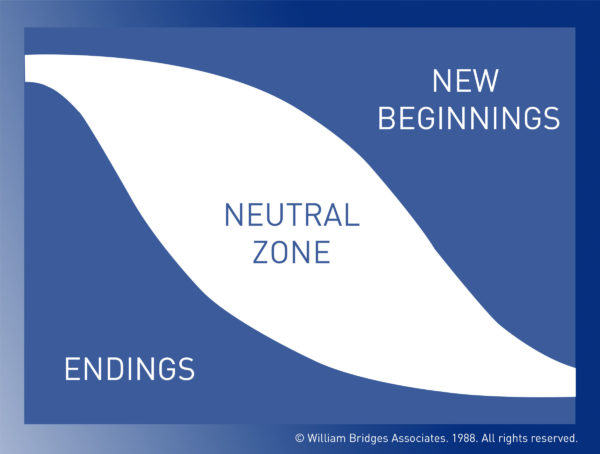
Change, Dr. Bridges said, was external and transition internal. He used the terms "endings" and "beginnings," not stop and start. A "neutral zone" was inserted for processing and renewal. And his writings remind us that everyone goes through a transition at their own speed.


Bridges Transition Model | William Bridges Associates

External change is losing loved ones, freedom access, or work itself. Internal transitions are the emotional and psychological responses to those complicated, sometimes heartbreaking developments that follow.  

All this is in the context of a global shock to economic, social, and healthcare systems that arrived in days, not months or years. Who had a global pandemic in their contingency plans?  

One way to gain insight into what people are going through, small business owners and their workers, is to understand transition or what's happening inside in response to transformative change. For example, how does someone cutting hair days just a few days ago but can no longer do so to pay their bills? How does an enterprise make payroll without an income?

How fast will appropriated government funds get to the neediest persons and businesses?  

Finding ways to deal with those realities is necessary for individuals and families to recover and move ahead. There's nothing easy about succeeding at that task, but the right actions speak louder than words.  

Crossing a great divide

In the coming weeks and months, living under varying public policy guidelines, consider the following for personal or corporate discussions--

-What's our assessment of the current crisis, and what does it mean for our business or nonprofit? And keep asking that question. Know as much as possible what's happening on the ground.

-What are we losing?  

-What's not over? What should we think about holding onto?  

-How much of "normal" is likely to return, and when can we know?

-Amid a crisis, how does one think with a clear mind?

-What are the more reliable sources of information for our business and employees?  

-How do we communicate with clarity and consistency, and how frequently?  

Crisis requires moral leadership

During a period of reordering, it's our responsibility to identify and keep alive those things of most significant value, such as one's faith; commitment to family; good character; a strong work ethic; and service to others. Those values are irreplaceable.   

As in all catastrophes, including outbreaks and wars, we'll get through this by showing courage and a selfless spirit, both inspiringly on display in doctors, nurses, first responders, and others who serve at significant risk for the benefit of all.    

Stay well.


Strategist.com

© Bredholt & Co. 


March 01, 2020

Getting the Right People on the Right Page

"No doubt, unity is something to be desired, to be striven for, but it cannot be willed by mere declarations."

--Theodore Bikel 

When was the last time you considered getting everyone on the same imaginary page? Have you ever thought that employing this overworked phrase can do more harm than good?  

That approach and its enforcement often remove much-needed diversity of thought. Too many of the same kinds of people, too close together, limit a group's ability to make difficult decisions.   

Some considerations come with unity. One benefit is consolidating time and energy around common goals--assuming they're the right ones. This is a potentially productive way to use limited resources to achieve the desired results.  

And this concept works best if colleagues are scattered, with some keeping watch on the periphery. Those on edge play a critical role in looking out for the business. In the center, one is less likely to know about changes that are materializing but not yet fully formed.
  

Image result for image of a blank sheet of paper
The right page?

However, if everyone is huddled on the wrong page, then you run a risk of the page folding. 
(See J. C. Penney)

The leadership agenda

The purpose of this post is to suggest that a leader gains a great deal of momentum at the outset by understanding and communicating what's most important to the enterprise. To accomplish that task, those at the top should begin by coming to terms with what needs to be done, not necessarily what they want to do. For example, the coronavirus may force many to adapt quickly as circumstances change beyond anyone's control.  

Thinking strategically may work best when divided into two parts. First, the leader begins with a sense of purpose and direction, then opens up the process having it informed and owned by the experiences of others.  

To help get there, we created "The Leadership Agenda," a tool that makes people accountable for their ideas and implementation through those around them. 

What does the agenda include?

Here are some suggestions--

o  Core idea. Why this organization?

Desired future. And how to get there.

Priorities. No more than three with a clear #1.

-With a person responsible for each.

Main messages. A stump speech in plain language. 

Critical issues. Three in rank order.  

-With a person responsible for each. 

Operational assessment.  

1. What needs changing or reorienting to support the strategic direction?

2. What has run its course or is not working and needs to be abandoned?

3. What is not working and needs fixing?

4. What are we not doing that needs initiating?

Positive outcomes 

A crowded page tends to be counterproductive as individuals responsible for strategic decisions are unclear about the primary goal. That fuzzy picture increases the possibility of confusion and the danger of going in the wrong direction.  

If execution happens, it's because the right people are on the right page, going in the right direction. (See Microsoft)

Prompts to help our thinking

To receive a free copy of "The Leadership Agenda" template, send a note to:

rbredholt@strategist.com.  Put "Agenda" in the subject line.  

This simple tool requires a quiet mind and a No. 2 pencil to clarify your organization's direction.


Strategist.com

© Bredholt & Co.


February 01, 2020

Where Was the Board?

"The first principle is that you must not fool yourself, and you are the easiest person to fool."

--Richard Feynman, Nobel Prize in Physics (1965)

There were over 1,400 CEOs who left their jobs from January through November 2019, according to Challenger, Gray & Christmas. In addition, just days ago, IBM announced Chief Executive Ginni Rometty was leaving. IBM said she was "stepping down" after eight years in that position. 

A tally of board member departures is harder to find.  

It's safe to say there's more pressure on executive leadership than governance regarding performance. For example, in baseball, owners fire the managers and trade the players. (Just ask the Houston Astros, Boston Red Sox, and New York Mets.)  

Who evaluates governance and its performance?  

Where boards are falling short

In a survey of 772 directors, "34% of those responding agreed that the board they served fully understood their companies' strategy. Only 22% said their boards were completely aware of how their firms created value, and just 16% claimed that their boards had a strong understanding of the dynamics of their firms' industries."  (McKinsey & Company, 2013)

Another McKinsey study of 604 C-suite executives and directors worldwide said that the primary pressure source for short-term performance and underemphasis on long-term value originated in the boardroom. (McKinsey & Company, 2014)

When things go wrong

The expectations of a director's fiduciary duty in legal terms are "loyalty (placing the organization's interests ahead of one's own) and prudence (applying proper care, skill, and diligence to decisions)."

Here are three examples where an absence of proper oversight and complex working relationships contributed to far-reaching personal and organizational misdeeds:

Case Study:  WorldCom

At one time, WorldCom was the second-largest long-distance telephone company in the U.S., after AT & T.  In 1997, WorldCom merged with MCI Communications, a $37 billion deal which was the largest merger to that point. A proposed merger between MCI and Sprint in 1999 valued at $129 billion was opposed by the U.S. Department of Justice and didn't go through.  

In that same year, with declining stock prices, WorldCom began using fraudulent accounting methods to disguise its decreasing earnings to maintain the cost of WorldCom stock. The fraud was initially estimated at $3.8 billion. Internal auditors revealed the scandal to the company's audit committee and 11-member board of directors in 2002. The board immediately removed the executives responsible for the scheme.  

On July 21, 2002, WorldCom filed for Chapter 11 bankruptcy protection.  

On March 15, 2005, Bernard Ebbers, former chairman, and CEO, was found guilty of fraud, conspiracy, and filing false documents related to the $11 billion accounting scandal. Mr.  Ebbers was sentenced to a prison term of 25 years at age 63. He died on February 2, 2020, at age 78, after being released from prison for deteriorating health.

The CFO, Scott Sullivan, and controller, David Meyers, entered guilty pleas to securities fraud and other charges.  

Case Study:  Wells Fargo Bank

Beginning in 2016, Wells Fargo Bank engaged in an account fraud scandal by creating millions of fraudulent checking and savings accounts on behalf of the bank's customers without their consent.

The U.S. Consumer Financial Protection Bureau fined Wells Fargo Bank $185 million due to illegal activity. Additional civil and criminal suits were nearing $2.7 billion at the end of 2018.  

Approximately 5,300 employees were fired for this cross-selling scheme. And former CEO John Stumpf was barred from the banking industry by the Office of the Comptroller of the Currency and forced to pay $17.5 million in penalties for failing to prevent the creation of fake accounts at Wells Fargo.  

An independent investigation report released in 2017 caused quite a stir. The Los Angeles Times called the information a "whitewash" for the directors. The San Francisco Chronicle labeled it "a perfunctory ... legal cover for the directors."    

The U.S. government recently announced that Wells Fargo had agreed to pay $3 billion to settle charges that the bank engaged in fraudulent sales practices for over a decade.  

Case Study:  Willow Creek Community Church

The nondenominational megachurch in South Barrington, Illinois (35 miles northwest of downtown Chicago) was founded on October 12, 1975, by Bill, Lynne Hybels, and Dave Holmbo. Additionally, Rev. Hybels created the Willow Creek Association and Global Leadership Summit, influencing pastors and lay leaders worldwide.  

As of December 2018, the church reported a weekend average attendance of 24,000 at eight locations in the Chicago area.  

Here's a timeline for Willow Creek's unraveling:  

-On March 23, 2018, the Chicago Tribune reported detailed allegations of sexual misconduct by Pastor Hybels. The Tribune also published that an internal review conducted by the Elders led to no findings of misconduct. However, three leaders of the Willow Creek Association's board resigned over what they believed to be a preliminary inquiry. Rev. Hybels denied the allegations.

-On April 20, 2018, Bill Hybels announced his immediate retirement as lead pastor of Willow Creek Community Church, initially slated for October of the same year. Steve Gillen, the pastor of the North Shore campus, was named interim senior pastor.*  

-On April 21, 2018, the Chicago Tribune and Christianity Today reported more misconduct allegations not in the original investigation.

-On August 5, 2018, The New York Times reported about another victim not included in previous investigations. Co-lead pastor Steve Carter resigned that same day.

-On August 8, 2018, the entire Elder Board and Co-lead pastor, Heather Larson, resigned following a joint apology for mishandling the investigation.  

-In September 2018, Willow Creek Community Church and Willow Creek Association announced the formation of an Independent Advisory Group (IAG) to investigate the allegations against the founder, Bill Hybels.  

A six-month independent review was conducted by four evangelical leaders--Jo Anne Lyon, general superintendent emerita, The Wesleyan Church; Gary Walter, past president, Evangelical Covenant Church; Margaret Diddams, provost, Wheaton College; and Leith Anderson, president, National Association of Evangelicals.

According to Religious News Service, the report, completed in February 2019, found the accuser's allegations against Rev. Hybels credible. However, the IAG study also found that the Elders and Willow Creek Association leadership failed to hold him accountable. 

What can we learn?

1. There's immense pressure on leaders in business and the nonprofit sector to succeed. However, those demands in no way justify illegal, immoral, or unethical behavior.  

2. Boards impact organizational culture the most through the leadership they put in place.       

3. "Why am I here," and "What difference do I make?" are questions often asked by new board members. All three case studies needed boards that understood their role of taking care of what belongs to others.  

4. The lessons of a bad experience can evaporate when wholesale personnel changes are made following a crisis. WorldCom went away. Wells Fargo Bank and Willow Creek Community Church still exist. Who is responsible for institutionalizing lessons learned?  

5. Under the right circumstances, anyone can be fooled.  


*The Elders announced on January 30, 2020, that Rev. Steve Gillen, interim senior pastor, is leaving in March of this year. The search for a permanent senior pastor at Willow Creek continues as the Elders released the two finalists they were considering for the role.  (www.willowcreek.org)


Strategist.com

© Bredholt & Co.    


January 01, 2020

The Strategic Mind

"It is a process of diverting one's scattered forces into one powerful channel."

--James Allen

Did you happen to shop at Target over the Christmas holidays? I went to one of their stores a few weeks ago to purchase an item and was pleasantly surprised by a redesigned interior--everything from attractive gray wood flooring; neatly stocked shelves; deliberately locating women's apparel closer to the front entrance, but especially the spotlights and circular lighting making the Big Box store glimmer with a new look.  

And that's one of the messages Target wants to send to the marketplace.   

At least some of the physical components of a turnaround by Target's CEO Brian Cornell and the leadership team were before my eyes.  


Related image
(C) Target Corporation

In 2017, up against giants Walmart ($514 billion revenue) and Amazon ($232 billion revenue), Target's board and top management bet $7 billion that more affluent shoppers still want an in-store experience provided the environment and customer service were inviting enough. So as a part of recreating itself, Target ($75 billion revenue) raised wages for a large number of its 320,000 employees as "guest" and "team member" satisfaction are one and the same.  


Developing a corporate strategy and implementing it close to the original plan is something to behold. But, unfortunately, few leaders pull that off, as looking ahead and seeing short is hard.

The leadership agenda

Reversing direction requires clear priorities. What made up the centerpieces of Mr. Cornell's leadership agenda? *

o  Spruced-up stores. Better lighting and longer sightlines. By 2020 almost 1,000 stores (out of 1,800) will have a new look.

o  Integrated e-sales. An upgrade to store locations makes it possible to pick up online orders near your home. For example, about 80% of Target's e-commerce sales involve stores.  

o  Speedier delivery. Rather than building capacity from scratch, which would have taken a lot of time, Target bought Shipt and Grand Junction to allow faster deliveries.  

o  Fresher brands. New and more profitable store brands, 20 at last count, earn higher margins and appeal to younger households.  

o  Selective tech. The goal with tech was practical and had an immediate payoff, so experimentation was pushed aside.  

Is yours a strategic mind? 

Before the first piece of flooring was laid or lighting hung, someone had to know what a refurbishing could look like and how that investment might change Target's direction.  

How else would a leader be able to communicate the main goal?  

Author Henry Mintzberg once observed that strategic thinking was "seeing."  The strategic mind sees ahead; of that, there's no doubt. The more significant question is how do they see ahead?  

Here are five ways of strategic thinking that Dr. Mintzberg uses to qualify a leader as having a strategic mind:

1. You cannot see ahead unless you can see behind. Any good vision of the future has to be rooted in the past.

2. Strategic thinkers must find the gem of an idea that changes their organization. That comes from a lot of digging, which is where treasures are found. Unfortunately, there's no big picture ready for seeing; each strategist has to construct his or her own. 

3. Strategic thinkers see differently from other people. They pick out the precious gems that others miss. They challenge conventional wisdom--the recipe, the traditional strategy--and thereby distinguish their businesses. 

4. Creative ideas must be placed into context to be seen in a world that is to unfold. Seeing beyond constructs the future--it invents a world that would not otherwise be.

5. For a thinker to deserve the label "strategic," he or she must be able to see it through (something only about 10% of leaders appear able to do, according to a global study by PwC).   

What's held in common

If there's one leadership tactic that improves a strategy's chance of success, it's this:

The more an organization shares in common, the less likely personal interests will prevail. The less an organization shares in common, the more likely personal interests will prevail.

An absence of shared understanding can cause a corporate-wide initiative to get off to a false start. Therefore it's well worth the time and effort to engage employees, customers, and vendors early on. Unfortunately, workforce studies consistently show that individuals at all levels rarely understand the purpose and strategy they are expected to fulfill.  

You can believe there were a lot of experience-based judgments to determine the direction Target has chosen. That said, no one can know everything from the beginning. The real learning is in the doing, now underway. 

Is the strategy working? 

Like most large enterprises, some things work, and others don't.  

Target reported sluggish holiday sales, with toys and electronics a disappointment. "We faced challenges throughout November and December in key seasonal merchandise categories, and our holiday sales did not meet our expectations," Chief Executive Brian Cornell said. 

However, Simeon Gutman, a retail analyst at Morgan Stanley, said: "Target's ability to manage the business well through weaker sales is the silver lining."    


*Published in FORTUNE Magazine, September 2019.  


Strategist.com

© Bredholt & Co.  


December 01, 2019

Humble Leadership

"You changed the game, man."

--Coach John Harbaugh to his Baltimore Ravens star quarterback, Lamar Jackson.

Here's the rest of that sideline conversation during a 49-12 blowout of the Cincinnati Bengals.

"And we're going to keep it going," Jackson said. 

(C) PressBoxOnline

Then comes this warm message from Coach Harbaugh:

"Do you know how many kids in this country will be wearing No. 8 playing quarterback for the next 20 years?"

Lamar Jackson, who became the first quarterback in National Football League history to throw at least 3,000 passing yards and rush for 1,500 yards in his first two NFL seasons, says with a measure of humility:

"I can't wait to see it when I get older, but I got to get to the Super Bowl right now."

The power of relationships

In their book, "Humble Leadership," father/son co-authors Edgar and Peter Schein put a spotlight on the power of relationships, openness, and trust. They turn away from a "superstar" concept and instead consider the positive outcomes when individuals learn and share for the greater good of the business.

Their idea is that a leadership process such as this can occur at any level, in any team or workgroup, in any meeting, and across all cultural boundaries.

Schein defines leadership as "always a relationship where successful leadership thrives in a group culture of high openness and high trust."  

In that sense, leadership and culture are two sides of the same coin, the book suggests.  

An unpretentious posture

I asked Dr. Schein if humbleness and humility are the same things.

"Our key point is that we don't think you have humility as a personality trait but as a situational feeling on the part of the would-be leader. An appropriate response would be--'I don't know enough to solve this complex problem I am facing; I am, in fact, dependent on my direct reports and team members; therefore, I must create a climate in which they will feel safe to speak up and collectively help to solve the problem.'"

He adds, "The goal is to know when leaders know enough to direct others and when they don't know enough, therefore seeking and accepting help."

According to executive placement firm Challenger, Gray, and Christmas, maybe organizations are ready for a "humble" approach as more than 1,300 CEOs have left their positions in 2019.  

Closer to home in Central Florida, one of those CEO departures is Tricia Stitzel, who is stepping down as Chair and CEO of Tupperware Brands. Stitzel exits with a nearly $2 million severance and a $125,000 consultant deal even though Tupperware's stock has fallen 75% from the start of 2019 and November 26th. 

Personization

Schein's introduces us to a new word, "personization," and defines it as:

Building a working relationship with fellow employees, teammates, bosses, subordinates, or colleagues is based on trying to see that person as a whole, not just in a role that he or she may occupy at the moment.

In case you're worried about having to be too nice, relax. The authors state that "personization is about building relationships that get the job done and that avoid the indifference, manipulation, or worse, lying and concealing that often arise in the workplace."

Image result for images of lamar jackson and teammates
Lamar Jackson and Ravens' teammates celebrate a win
over New England Patriots, November 13th, 2019.
(C) Todd Olszewski/Getty Images

Quoting from the book:  "We don't need to become friends and learn all about each other's  private lives, but we have to learn to be open and honest around the work issues."


Is humility proven?

In The Wall Street Journal, Matthew Kassel says humble leaders do not always inspire confidence among financial analysts. "While humble CEOs aren't any more or less capable than their brash peers, they tend to benefit from an "expectation discount," Kassel notes.  

This leadership style doesn't appear strong at first but delivers better results, perhaps as much as a 7% increase in total return annually, according to recent studies on the subject.

More research is needed, but there's something to be said about the positive track record of contemplative leadership.  

Maturity counts 

I watched the Baltimore Raven's run over the Los Angeles Rams 45-6 at the Coliseum on ESPN's Monday Night Football (November 25th, 2019). On display was an exciting second-year quarterback building relationships around openness and trust.  

Lamar Jackson is dependent on his coaches and a highly-skilled offensive and defensive roster. They are more familiar with the ins and outs of professional football and the toll a long season takes on everyone. That explains the necessity of older talent in the mix.

The Ravens v. Rams game was a visible reminder that if Baltimore made it to the Super Bowl in South Florida (Miami) in February 2020, it would be a combination of gameplan execution, staying healthy, and, as the book concludes, "personal cooperation and trusting relationships; the kind that makes for friendships and effective teams." 

That effort is being led by a 22-year-old quarterback from the University of Louisville who provides confident and humble leadership.

------------------

Update:  The Baltimore Ravens lost to the Tennessee Titans in the NFL playoffs 28 - 12. Lamar Jackson said afterward--"We just beat ourselves. I had a lot of mistakes on my behalf. Three turnovers. That shouldn't happen."  


Strategist.com

© Bredholt & Co.