November 01, 2018

Delivering Exceptional Service

"From now on the essence of this hotel will be speed. If a customer asks you for a three-minute egg, give it to them in two minutes. If they ask you for a two-minute egg, give it to them in one minute. If they ask you for a one-minute egg, give them the chicken."

--Groucho Marx, "A Night in Casablanca"

Uber Technologies, Inc. said that within three years, the company intends to expand its services to include a fleet of food-delivery drones called, UberEats.  

Instead of having your Domino's Deluxe Pizza brought to the house or apartment by a friendly delivery person, that box, wafting with the smell of your favorite toppings, would sail through the air, landing at your doorstep, hot and ready to eat.

While UberEats already has a ground delivery service, the announced timeline calls for a drone service to be in place by 2021, according to the original Uber posting on its website. 

Several big tech companies, including Amazon and Uber, are keeping a George Jetson future in front of hungry investors and media. Over $3.5 billion has been invested in food and grocery delivery services in 2018. As a result, Instacart, Inc., Postmates, Inc., and DoorDash, which delivers Wendy's hamburgers and other menu items, are vying for ways to carve out positions in this emerging market.

In the meantime  

This past summer, I made a business trip from Kalamazoo, Michigan, to Minneapolis, by way of Detroit, that resembles an obstacle course. During each segment, I became increasingly dependent on others to help get me to my destination safely and on time by delivering exceptional service:
Amtrak Station in Kalamazoo 

When my train was posted late, Tod, the Amtrak station manager, offered to find a ground transportation service at Dearborn Station, about 30 minutes from Detroit Metropolitan Airport. Of course, there's nothing unusual about a late Amtrak train. But, unfortunately, that happens more than it should.  

What was different on that Thursday in June was Tod's effort to ensure we didn't miss our flight to Detroit.

Amtrak Station in Dearborn to Detroit Metro

Eddie, our polite and knowledgeable driver, navigated heavy congestion and construction between the train station and the airport. All for a reasonable fee.       

Delta in Terminal A

As it turns out, my dash to the gate was unnecessary. Delta 23 was running a little behind, and boarding had yet to begin. Then Delta announced that the scanning system for reading boarding passes was down. So all 167 passengers on this oversold flight would have to be boarded manually through a backup plan.  

Susan, the gate agent, called for boarding and began a tedious process of getting passengers onto the Boeing 737-900 plane. I asked how she felt about being alone at Gate 70 in Terminal A with a broken system. Her response: "You do what you have to do."  

Within a reasonable amount of time, everyone was boarded, and Delta 23 nonstop to Minneapolis was safely on its way.  

Hertz at Kalamazoo/Battle Creek International Airport

I returned to Kalamazoo by renting a Hertz car at Detroit Metro Airport and driving two hours west on Interstate 94 to the Portage Road exit. Unfortunately, in my haste to fill out the rental agreement (gas, mileage, time) and get home, I left my mobile phone in the front seat.  

Fortunately, when the associate manager, Michael, did the vehicle inspection, he found the phone and held it for me.   

With appreciation

I am grateful to Tod, Eddie, Susan, and Michael for their spirit and quality service. Each acted as much out of who they were as what they were trained to do.  

What happens next?

Who knows what will unfold when it comes to delivering products and services through various methods, including air. With technology and artificial intelligence advancing rapidly, the sky may be the limit.  

Finding ways for any business to stand out from the competition is essential. One path to success is providing exceptional face-to-face customer service. Then, when necessary, give them the chicken.  

Delivering what's promised daily is not easy, but that's the goal.  

Your Domino's Ultimate Pepperoni Pizza will still arrive by car, truck, or SUV--delivered by a mortal being. However, when The Wall Street Journal contacted Uber about a flying drones program, the company removed that posting from its website.  

Apparently, the air version of UberEats has been temporarily grounded.      


Strategist.com

(C) Bredholt & Co. 


October 01, 2018

What a Game!

"You'll like baseball. It's a civilized pastime."

--From the Broadway musical, "Ragtime." 

Fifty years ago this month, the Detroit Tigers won the 1968 World Series 4 games to 3 over the exceptionally talented St. Louis Cardinals (Curt Flood, Mike Shannon, Orlando Cepeda).  

Detroit (Al Kaline, Denny McLain, Jim Northrup) was down 3 games to 1, and Tigers fans, including me, thought there was little chance the Motor City team could win a seemingly insurmountable three straight. Especially with Game 7 being played under the Arch in St. Louis against future Hall of Fame pitcher Bob Gibson.  

Detroit pitcher Mickey Lolich won three complete-game victories and was named World Series MVP. The improbable comeback was primarily due to Lolich's left arm--and Willie Horton's perfect throw in Game 5 to catcher Bill Freehan who tagged out Lou Brock as Brock decided to stand up and not slide into home plate. 

A baseball era ended Thursday, October 10th at 3:07 p.m., Central Time, with the final out at Busch Memorial Stadium. The Tigers won 4-1 before a sellout crowd of 54,692.

There are several historical observations about the '68 World Series in which the Tigers were managed by Mayo-Smith and the Cardinals by another future Hall of Famer, Red Schoendienst. Most notably, that was the last World Series where American and National League champions would enter a Fall Classic without going through a playoff process. In succeeding years, TV money, seven-figure contracts, best of five and best of seven series, plus team expansions, would launch baseball into a totally different era.  

That was then       

If the business model of professional baseball was about to change significantly, so was the nature and development of its future talent.  

Five decades later, what is the status of baseball pipelines such as Little League, high schools, college, farm systems, and minor leagues?  

"They can't play catch," says Jack Thompson, a 40-year high school baseball coach from California who spoke with The New York Times. So while Thompson says young players can scorch line drives, hit 400-foot homers, and hurl blazing fastballs, these future major leaguers must be taught how to play catch.  

The story clarifies that the new "holy grail" is a college athletic scholarship. However, in pursuit of that goal, "the fundamentals are falling by the wayside in favor of flashier skills like big-league-style hitting and pitching," according to sportswriter Bill Pennington.  

The report adds that private coaching, specialized camps, and travel teams all have the same objective--to place youth players in college recruiting showcases.  

As a result of these new values, Pennington concludes, "a generation of top ballplayers has, in most cases, spent little time learning how to accurately throw across the diamond; catch a fly ball; field a ground ball and turn a double play; run the bases effectively; make a tag at a base, or, God forbid, bunt."

Where are the parents?

On a Southwest flight from Kansas City to Chicago with a sports consultant specializing in identifying young talent for major colleges and professional sports, I learned that the parent is often the driving force for these changes in player development and recruiting.  

My seatmate said that even the advent of newly designed uniforms by traditional football programs (Notre Dame; University of Miami; Iowa State; Arizona State; Army and Navy; Texas A & M) is an enticement to high school athletes and their families to come and be part of something new.  

Well-rounded players

Let's take this idea of specialization and move it into the marketplace.

What are employers looking for? 

They want employees who are talented but can also work as a team. Who knows how to play catch and maybe hit an occasional home run. They're after personalities more fully developed in all aspects of life. Those who are composed and balanced in their dealings with colleagues and customers.  

There's no going back in time, and the past was never as good as we remember it to be. Nonetheless, hard work, proficiency, and maturity are traits as desirable in people today as they were fifty years ago. 

For inspiration, look at the Detroit Tigers and St. Louis Cardinals, whose 1968 rosters were filled with players of that kind.  


Strategist.com

(C) Bredholt & Co.


September 01, 2018

On Becoming a CEO

"Nobody knows how to be a CEO. It's something you have to learn. It's a very lonely job."

--Ben Horowitz

In his valedictory Corner Office column, Adam Bryant summarizes a decade of interviews with 525 Chief Executive Officers (CEOs). "What a rare vantage point a CEO has for spotting patterns about management, leadership, and human behavior," he notes.

What else can we learn from a rich trove of Chief Executive Officer wisdom?

Themes

After sorting through the insights, Bryant begins by offering three themes from those interviews:

1. Applied curiosity. CEOs tend to question everything. They want to know how things work and wonder how they can be made to work better. In addition, they're curious about people and their backstories.

They wonder less about the right career path and make the most of whatever they choose. Lessons learned from their experiences are crucial to their development.

2. Challenges are motivating. The last thing this category of leadership wants is to be comfortable.  

3. Management discipline. On the way to the top, the focus is on doing the current job well. If the concern is more about the job you want than the job you have, that's a problem. And those nearby can sense when you're emotionally absent from your current position. There's nothing wrong with thinking and planning ahead. But the focus should be on building a track record of success. When you do, people notice.

It's not simple

Leadership is a series of paradoxes. For example, needing humility and confidence at the same time.

The highest attribute

Trustworthiness.

Making the right hiring decisions

If you could ask somebody only one question, and you had to decide on the spot whether to hire them based on their answer, what would it be?

"What are the qualities you like least and most in your parents?" (Bob Brennan, CA Technologies)

A CEO story

As told by Bill Green, chief executive of Accenture ...

"I was recruiting at Babson College. This was in 1991. The last recruit of the day--I get this resume'. I get the blue sheet attached to it, which is the form I'm supposed to fill out with all this stuff, and his resume' is attached to the top. The resume' is very light--no clubs, sports, nothing. Babson 3.2 (GPA). Studied finance. Work experience: Sam's Diner, references on request.  

"It's the last one of the day, and I've seen all these people come through strutting their stuff, and they've got their portfolios and semester study abroad. Here comes this guy. He sits. His name is Sam, and I say:  'Sam, let me just ask you, what else were you doing while you were here?'  

"He says, Well, Sam's Diner. That's our family business, and I leave on Friday after classes, and I go to work till closing. I work all day Saturday till closing, Sunday until I close, and then I drive back to Babson. So, I wrote, 'Hire him,' on the blue sheet. He had character. He faced a set of challenges. Finally, he figured out how to do both."

What else should we know?

"It's work ethic," Green said. "You could see the guy had charted a path for himself to make it work with his situation. He didn't ask for any help. He wasn't victimized by the thing. He said, 'That's my dad's business, and I work there.' Confident. Proud."

A desirable trait

What's to admire about successful CEOs? The columnist Bryant concludes: "They own their job, whatever it is."


Strategist.com
(C) Bredholt & Co.


August 01, 2018

Lessons from Tham Luang Cave

"We're not sure if this was a miracle, science, or what."  

--Thai Navy SEALS posted on Facebook

A courageous and exhaustive 18-day rescue effort to bring 12 soccer players, aged 11 to 16, out of a treacherous cave in Mae Sai, Thailand, had an innocent beginning. A decision on June 23, 2018, to celebrate a team member's 16th birthday by exploring the Tham Luang Cave turned into ten days of uncertainty for the players, coach, families, and a watchful world.    

The dozen Thai boys, members of the "Wild Boars" soccer team, and their coach, Ekkapol Chantawong, were found on July 2. They were safely removed from the Tham Luang Cave but not without a lot of 12-hour days and the loss of a Thai Navy SEAL, 38-year-old Samarn Gunan, who died placing oxygen tanks along the passageway to make their rescue possible.  

News reports indicate that the head of at least one Hollywood production studio in Thailand is exploring ways to adapt this incredible story.


Image result for images of soccer boys in thailand
(C) Wild Boars Soccer Team, Mae Sai, Thailand AP 

What can we learn?


The military, and those in the cave rescue business (yes, that's a business), will spend time looking carefully at this near-tragedy. However, the death of diver Samarn Gunan is tragic. They will document the process, as we should try to learn from the experiences of others.  

Based on interviews with soccer players, coaches, families, and rescue workers, what can be gleaned from the miracle in Mae Sai?

1. Pay attention to warning signs. 

There are signs at the entrance to Tham Luang Cave warning visitors not to take risks. It's reported that locals are advised not to enter during the monsoon season, as the cave system rapidly floods with water. Additionally, parents advise their children to stay away from the cave.  

(There were weather warnings on July 19, 2018, ahead of the Duck Boat tragedy at Table Rock Lake in Branson, Missouri. Seventeen people died, including nine members of one family.)

The RMS Titanic, a British ship that sank on April 15, 1912, in the North Atlantic, had received several warnings about icebergs, but they were mostly ignored. As a result, nearly 1,500 passengers and crew lost their lives that night.  

Sometimes warning signs are posted; other times, they're not. If they are, we ignore them at our own peril and those under our care.

It's worth noting that consequences may be unintended — but also foreseen.  

2. Don't panic.  

Robert Laird, the co-founder of International Underwater Cave Rescue and Recovery, observed that "rescues are rare."  In an interview in The Atlantic, Laird says that when cave divers get in serious trouble, they usually die. "There is no one to rescue, just a body to recover," he adds.  

Notes Laird, "The worst thing you can do is panic."   

We know from interviews with the boys that the first few days were marked by intense panic. It was not until Day 3 that Coach Ek could get the soccer team to stop crying. After that, the focus shifted to quietness, deep breathing, and getting sleep. That emotional reversal created a frame of mind in which survival was possible.    

3. Admit the need for help.  

Military experts. International cave divers. Medical personnel. Farmers. And a Thai rock singer. They all played roles in the rescue effort.  

Narinthorn Na Bangchang, a popular entertainer from Bangkok, who had flown to Mae Sai, posted her equipment needs on her Facebook page. Bangchang's followers responded generously. For example, a request for 200 regulator air tanks resulted in 400 tanks being donated.  

She also found an expert cave diver who had trained the Thai Navy SEALs.     

In addition to pumps that removed billions of liters of water from the area to make the rescue possible, the retinue of resources included over 100 divers, 500 air tanks, 1,000 support personnel, 900 police officers, including police ambulances, and 5,000 meals each day for people on the ground.  

The Thai Navy SEALs are trained in open-water diving, not cave diving. They recognized a need for more specialized expertise and welcomed experienced volunteers.  

4. Persistence pays off. 

When the Thai Navy SEALS arrived at the cave on June 25, they had gotten inside as far as Pattaya Beach, a piece of dry ground four kilometers (2.1 miles) from the mouth of the cave. They found footprints and shoes confirming that the boys had passed this way.

When the SEALS decided to turn back due to a lack of air canisters and coming rain, they were just 400 meters (.2 miles) from where the boys and their coach had taken shelter.

Heavy rains would fill the cave in another week, before anyone could return.

However, giving up was not an option.

"We had to dive, walk, climb through stone and rock, but we had to keep fighting," says Thai SEAL Commander Arpakorn Yookongkaew.  "If we did not keep moving, there would be no hope for the children."  

Using guidelines set by Belgium-born Ben Reymenants and his diving partner, British divers finally found the boys and their coach on July 2. 

In the meantime, the soccer team exchanged letters with their parents, delivered by divers, which further encouraged the boys and their coach.

5. Technology has limitations.  

What about hi-tech?

"The Silicon Valley model for doing things is a mix of can-do optimism, a faith that expertise in one domain can be transferred seamlessly to another, and a preference for rapid, flashy, high-profile action. 

"But what got the kids and their coach out of the cave was a different model: a slower, more methodical, more narrowly specialized approach to problems," observed Dr. Zeynep Tufekci from the University of North Carolina.     

Dr. Tufekci also noted that a "safety culture" approach to problem-solving, combined with decades of training, enabled Chesley Sullenberger to safely land US Airways Flight 1549 in New York's Hudson River on January 15, 2009, without incurring any loss of life.

Undoubtedly, technology will have a role in future cave rescues. Still, it will likely support a "slow is smooth--and smooth is fast" approach used by a consortium of Navy SEALS and international cave rescue experts in Thailand. 

6. Leaders go last.

While in the cave, the soccer coach apologized to the parents in a handwritten note sent through divers. Coach Ek promised to take care of the children during the rescue mission "as best I can." And he did.


Image result for coach ek images thailand
(C) Coach Ek. Ek Facebook Page

It was fitting that the coach was with the last four boys to be rescued on July 10. Staying behind until everyone was safely removed was the right thing to do.  

No doubt Coach Ek, who was orphaned at the age of 10, will have plenty to reflect on regarding his decision to enter the Tham Luang Cave with the soccer team. Successful leaders make mistakes, but they don't repeat the same mistakes twice.

A lesson for everyone is summed up by the late actor and social commentator Will Rogers, who, in a different era and a world away, once said, "Good judgment comes from experience, and a lot of that comes from bad judgment."       


Strategist.com

©  Bredholt & Co.  


July 01, 2018

Trends Worth Watching

Here are 10 U.S. and global demographic trends that may be of interest to you:

1. Millennials are projected to be the U.S.'s largest living adult generation in 2019. More than Baby Boomers. millennials are already the largest generation in the U.S. labor force, making up 35% of the total

2. Americans are more racially and ethnically diverse than in the past. The U.S. is projected to be even more varied in the coming decades. By 2055, the U.S. will not have a single racial or ethnic majority. 

3. Americans' lives at home are changing. After a decades-long trend, just half of U.S. adults were married in 2015, down from 70% in 1950. Moreover, with marriage in decline, cohabitation is increasing, with the most significant gains among those ages 50 and older--doubling between 1990 and 2015.

4. Changing household structures. A record number of Americans (nearly 61 million) were living in multi-generational households, including two or more adult generations or grandparents and grandchildren.

5. America's demographic changes are shifting the electorate – and American politics. The 2016 electorate was the most diverse in U.S. history due to strong growth among Hispanic eligible voters, particularly U.S.-born youth.

6. The share of Americans who live in middle-class households is shrinkingU.S. adults living in middle-income families fell to 50% in 2015, after more than four decades in which those households served as the nation's economic majority.

7. Christians are declining as a share of the U.S. population. And the number of U.S. adults who do not identify with any organized religion has grown. So while the U.S. remains home to more Christians than any other country, the percentage of Americans identifying as Christians dropped from 78% in 2007 to 71% in 2014. 

By contrast, the religiously unaffiliated have surged seven percentage points in that period to make up 23% of U.S. adults last year. This trend has primarily been driven by millennials, 35% of whom are religious "nones." 

8. The world is aging. The demographic future for the U.S. and beyond looks very different than the recent past. Growth from 1950 to 2010 was rapid — the global population nearly tripled to 7.6 billion. However, population growth from 2010 to 2050 is projected to be significantly slower and is expected to tilt strongly to the oldest age groups globally and in the U.S. 

9. U.S. population is still growing. The latest estimates show 325.7 million as of 2017. That's up from 308.7 million in 2010. The Wall Street Journal reports a "lull in the U.S. birth rate since the 2007-2009 recession. As a result, the country now relies on immigrants, typically young adults, to slow its aging."

10. More years in retirement. As longevity rises over time, people spend more time in retirement. Between 1962 and 2010, the average time spent in retirement rose by five years (from 10 to 15 years). As a result, life expectancy increased by eight years. By 2050 the years in retirement are projected to reach 20.  


Sources:

Pew Research Center; U. S. Census Bureau; The National Academies of Science, Engineering, and Medicine; and Compassion International 


Strategist.com

(C) Bredholt & Co.   
June 01, 2018

Books of Summer

"A person only learns in two ways, one is by reading, and the other by association with smarter people."

--Will Rogers

Read any good books lately?

A close look at the U.S. populous finds millennials are the top readers. According to the latest Pew Research Center study on reading, 18-29-year-olds are the age group most likely to have read a book in any format in the past year. And they generally prefer print to e-books, which have plateaued since 2016.

The Pew study shows the typical American has read four books in the past year. 

What to read?

We love books. Our reading list generally comes from recommendations and reviews. 

Here are five books in our 2018 summer library that would contribute to your personal and professional development:

1. "Character." By Samuel Smiles. Serenity Publishing. 254 pages.

"Character is one of the great motive powers in the world. In its noblest embodiments, it exemplifies human nature in its highest forms." --Samuel Smiles

We can't say enough about this topic. Character is an often overlooked strength when interviewing and assessing personnel. Exemplary behavior, and its many attributes (honesty, integrity, manners), are needed now more than ever.

2. "Silence." By Erling Kagge.  Pantheon Publishers. 144 pages. 

"Twenty-five years ago, the Norwegian adventurer Erling Kagge trekked solo across Antarctica without a radio (actually, the aviation company that flew him to the coast insisted that he take one, and he did—but he dumped the batteries in the plane's trash bin). The experience of being alone for 50 days inspired this book: a meditation on the need for, and meaning of, silence."

--The Wall Street Journal BookShelf 

3. "On Grand Strategy." By John Lewis Gaddis. Penguin Press. 384 pages.

Winner of the Pulitzer Prize.   

"The best education in grand strategy available in a single volume ... a long walk with a single, delightful mind." --John Nagl

4. "Lead Yourself First." By Raymond M. Kethledge and Michael S. Erwin. Bloomsbury USA. 240 pages.  

A guide to the role of solitude in leadership, including profiles of historical and contemporary figures who have used privacy to lead with courage, creativity, and strength. 

--Publisher's comments.  

5. "Alone Together." By  Sherry Turkle. Basic Books. 400 pages.   

"Technology has become the architect of our intimacies. Online we fall prey to the illusion of companionship, gathering thousands of Twitter and Facebook friends and confusing tweets and wall posts with authentic communication. But this persistent connection leads to a deep solitude. As technology ramps up, our emotional lives ramp down."   

--Publisher's comments.


To quote Wordsworth ...

"Books, we know, 
Are a substantial world, both pure and good,
Round which, with tendrils strong as flesh and blood,
Our pastime and our happiness can grow."


Strategist.com
(C) Bredholt & Co.


May 01, 2018

The Persuader's Tool Box

"Character may almost be called the most effective means of persuasion."

--Aristotle

Creating a persuader's toolbox is one way of addressing a variety of leadership styles, settings, and topics. Doing so reminds me of my dad's toolboxes filled with hammers, pliers, screwdrivers, wrenches, and tape measures.       

A tool that's often overlooked is a question. Whether it's a formal presentation or conversation, what will make the listener want to agree with you? And in your situation, what's the best way to make that happen?

In addition to a legitimate proposition and asking the right questions, what else should be in the persuader's toolbox?

o  A persuasive theory

A persuasive theory seeks a favorable response from the audience. It begins with "why."    

Carefully chosen language becomes a motivating argument that causes others to want to decide in favor of (fill in the blank). The theory, or reason to believe you, should be communicated succinctly in a few sentences. Offering too much information is likely to overwhelm an audience.  

Image result for images for "word"
(C) Oxford Dictionary
Think about how preparation in the early stages might improve the chances for success. The presenter's job, not the audience, is to sort through information in advance.

As Robert Louis Stevenson once said, "All speech is a dead language until it finds a willing hearer." 

o  Stories and themes

We were asked to arrange a mock jury. The law firm and jury consultant put the package together. After that, recruiting participants was up to us. That engagement prompted a closer examination of how lawyers try to persuade juries. 

What did we learn?

Experienced courtroom practitioners attempt to know their juries (or judges) while rolling out what they hope is a persuasive theory of the case (See United States Government v. Microsoft Corp., 2001)
Image result for images for microsoft logo
(C) Microsoft
"A skillful trial attorney knows how important it is to join a series of facts with a unifying theme as jurors deliberate and rely on themes to sort out the evidence. If attorneys don't provide the theme, jurors will do it for themselves," according to University of Washington law professor William S. Bailey. 

Employees, customers, voters, and even congregational members, are juries of their own making and require context by which to make decisions.  

In his autobiography, prominent litigation attorney David Boies writes: "There is much to be said for staying on message, but when you seek to persuade, you must address the concerns of the people you are trying to convince."  

Image result for images for coca cola
(C) Coca-Cola
What's the difference between a story (Coca-Cola's history) and a theme ("More Than a Soda Company")?  

"Stories are about the growth of character. They provide the mythic and emotional skeleton. Themes are the development of ideas and conceptual coherence," says Tristine Rainer. Powerful themes are those that resonate with ordinary human beings. A good theme acts like glue, enabling a few details to stick.    

Ask yourself--do you need a story or theme to persuade? Likely both.   

o  Rule of 3  

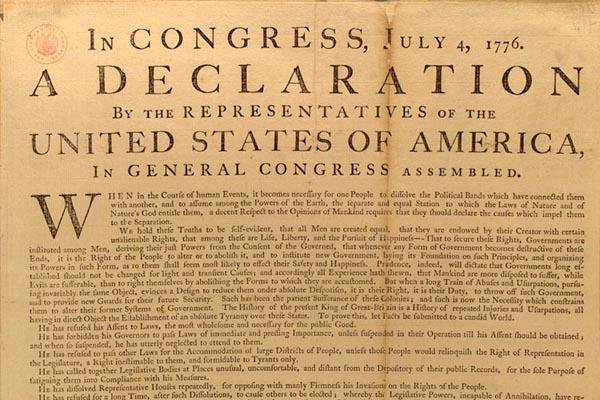
In Forbes Magazine, Carmine Gallo makes a strong case for staying close to the "Rule of 3" when presenting ideas. Gallo begins by quoting the U.S. Declaration of Independence, which celebrates three inalienable rights:

-Life
-Liberty
-And the pursuit of happiness

Image result for images declaration of independence
Public Domain
He reminds us that those three powerful ideas inspired France to arrange its freedoms into three groups: "Liberty, equality, and fraternity."

Gallo says Apple co-founder, Steve Jobs, loved threes. Macintosh, iPod, and iPhone. The iPad came in three models:  16, 32, and 64 GB of flash storage. The iPad was "thinner, lighter, and faster than the original."  

While our April Strategist Post reported that attention spans have much to do with the person and context, using only three pieces of information (or words) increases the likelihood of some retention on the listener's part.

Maybe that's why preachers are trained to prepare three-point sermons.  

The longer the list, the more challenging the recall.  

You get the idea.

o  Five persuasive words

Gregory Ciotti is a gifted copywriter. I came across his "copy blogger" website and found his wordsmithing approach to persuasion intriguing.   

Here are his five persuasive words:  

1. You     

Using someone's name is even better.

2. Free   

But used only when it makes sense and only in the proper context.

3. Because   

People simply like to have a reason for doing what they do (Dr. Cialdini). 

4. Instantly  

We wanted things yesterday. This idea is showing up everywhere.

5. New

New fixes to old problems. New features and improvements. New designs.

o The 3-6-9 principle

Something worth considering is the 3-6-9 principle from Robert Dilenschneider.  Mr. Dilenschneider is a professional acquaintance who, fifteen years ago, conducted a seminar for a board retreat that featured this multiplication formula:  

3x:   Number of times it takes to make an impression.

6x:   Number of times it takes to be reached.

9x:   Number of times it takes to be believed.  

Image result for images for the word repetition
(C) dreamsOin1digital
This reinforcing matrix is a reminder that one time is not enough when attempting to deliver persuasive-type messages.    

o  Who you are

Content and context are vital to persuading--including the right platforms. But nothing is as important as your own character.  

A lot of what it takes to get and hold someone's attention, to be persuasive, rests with the individual doing the persuading. So Aristotle reminded us of a robust causal relationship between character and convincing others.  

The toolbox may help, but successful persuasion is up to you.

Strategist.com

(C) Bredholt & Co.