"There is no expedient to which a person will not resort to avoid the real labor of thinking."
--Dr. Robert Cialdini
In the first of a series of posts on the topic of "persuasion," we look at Dr. Cialdini's ideas and research findings. They're the result of a lifetime of study while serving as professor of psychology and marketing at Arizona State University, and as visiting professor at Stanford University.
Quotable quotes
Recently Farnam Street newsletter offered quotes from Dr. Cialdini on persuasion. Here are four that caught our attention ...
"We seem to assume that if a lot of people are doing the same thing, they must know something we don't."
"Since 95 percent of the people are imitators and only 5 percent are initiators, people are persuaded more by the actions of others than by any proof we can offer."
"In part, the answer involves an essential but poorly appreciated tenet of all communication: what we present first changes the way people experience what we present next."
"As the stimuli saturating our lives continue to grow more intricate and variable, we will have to depend increasingly on our shortcuts to handle them all."
A path to successful persuasion
Here are Dr. Cialdini's six "Principles of Persuasion:"
No. 1: Reciprocity
Simply put, people are obliged to give back to others the form of a behavior, gift, or service that they have received first.
No. 2: Scarcity
People want more of those things they can have less of.
No. 3: Authority
This is the idea that people follow the lead of credible, knowledgeable experts.
No. 4: Consistency
People like to be consistent with the things they have previously said or done.
No. 5: Liking
People prefer to say "yes" to those that they like.
No. 6: Consensus
Especially when they are uncertain, people will look to the actions and behaviors of others to determine their own.
Learn more about the six principles.
His book, "Influence, The Psychology of Persuasion," which has sold more than three million copies, may be purchased here.
www.strategist.com
(C) Bredholt & Co.
March 01, 2018
February 01, 2018
Stratagem Horribilis
"Effective strategists are not people who abstract themselves from the daily detail but quite the opposite: they are the ones who immerse themselves in it, while being able to abstract the strategic messages from it."
--Henry Mintzberg
The critics argued that the planning of Passchendaele in the fields of Flanders was carried out in almost total ignorance of the conditions under which the battle had to be fought. No senior officer from the Operations Branch of the General Headquarters, it was claimed, ever set foot (or eyes) on the Passchendaele battlefield during the four months that the battle was in progress. 2
Daily reports on the condition of the battlefield were first ignored, then ordered discontinued. Only after the battle did the Army chief of staff learn that he had been directing men to advance through a sea of mud. 3
A Canadian Corps of 100,000 strong was ordered to the Passchendaele front, east of Ypres, in mid-October 1917 to relieve New Zealand and Australian troops.
Sir Arthur Currie, commander of the Canadian Corps, objected to the battle, fearing a significant number of soldiers would lose their lives due to the physical conditions of the terrain. But, under orders, Currie began getting his troops ready to fight, knowing deliberate preparations, primarily for artillery and engineers, were the key to advancing over the damaged landscape.
Nearly 16,000 Canadian soldiers fell in battle between mid-October and mid-November while capturing the targeted ridge. 6
--Henry Mintzberg
The Battle of Passchendaele
The disturbance at the infamous World War I battle of Passchendaele (Third Battle of Ypres), conducted between July and November 1917, was not the wind but the rain, Northeastern France's heaviest rainfall in 30 years. It was sunny when the plans were made at corps headquarters; as a result, 275,000 British troops fell. 1
According to historians, the goal of the British commander, Sir Douglas Haig, was to destroy German submarine bases on Belgium's northeast coast. Going through British-held Ypres was the chosen route.
 |
| Sir Douglas Haig, Commander in Chief, British Armies, World War I (C) The Long, Long Trail UK |
The critics argued that the planning of Passchendaele in the fields of Flanders was carried out in almost total ignorance of the conditions under which the battle had to be fought. No senior officer from the Operations Branch of the General Headquarters, it was claimed, ever set foot (or eyes) on the Passchendaele battlefield during the four months that the battle was in progress. 2
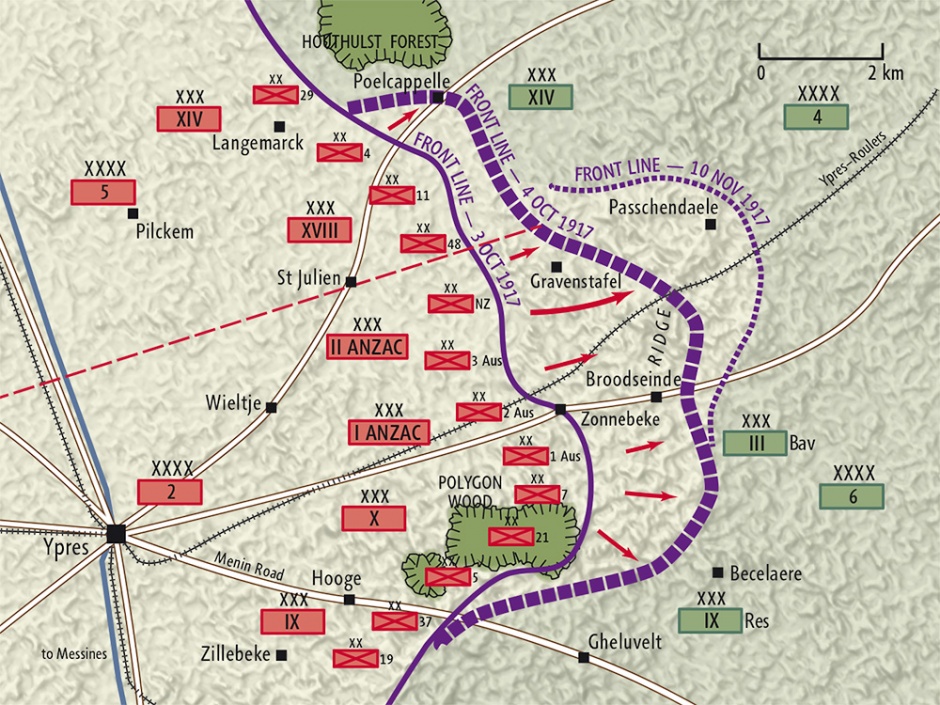 |
| Battle of Passchendaele Map (C) NZ History |
Daily reports on the condition of the battlefield were first ignored, then ordered discontinued. Only after the battle did the Army chief of staff learn that he had been directing men to advance through a sea of mud. 3
The "great plan" was implemented despite the effect of the steady, drenching rain on the battlefield--despite the fact that the guns clogged, that soldiers carrying heavy ammunition slipped off their paths into muddy shell holes and drowned, that the guns could not be moved forward and the wounded could not be brought backward. 4
The book "A Short History of World War I" says: "Still the attack went on; they slept between sheets at corps headquarters and lamented that the infantry did not show more offensive spirit."
"A staff officer ... came up to see the battlefield after it was all quiet again. He gazed out over the sea of mud, then said half to himself, "My God, did we send men to advance in that?" after which he broke down weeping, and his escort led him away."5
"A staff officer ... came up to see the battlefield after it was all quiet again. He gazed out over the sea of mud, then said half to himself, "My God, did we send men to advance in that?" after which he broke down weeping, and his escort led him away."5
Canadians to the Front
A Canadian Corps of 100,000 strong was ordered to the Passchendaele front, east of Ypres, in mid-October 1917 to relieve New Zealand and Australian troops.
Sir Arthur Currie, commander of the Canadian Corps, objected to the battle, fearing a significant number of soldiers would lose their lives due to the physical conditions of the terrain. But, under orders, Currie began getting his troops ready to fight, knowing deliberate preparations, primarily for artillery and engineers, were the key to advancing over the damaged landscape.
Nearly 16,000 Canadian soldiers fell in battle between mid-October and mid-November while capturing the targeted ridge. 6
Passchendaele Battle Summary
105: Number of days battle lasted
275,000: Casualties under British command (average 2,100 per day)
220,000: Casualties under German command
90,000: Number of bodies never identified (42,000 not recovered)
4.25 million: Estimated number of shells fired
Source: Casualties and Munitions
__________________
In Flanders Fields
Source: Casualties and Munitions
__________________
In Flanders Fields
In Flanders fields, the poppies blow
Between the crosses, row on row,
That mark our place; and in the sky
The larks, still bravely singing, fly
Scarce heard amid the guns below.
We are the Dead. Short days ago
We lived, felt dawn, saw sunset glow,
Loved and were loved, and now we lie
In Flanders fields.
Take up our quarrel with the foe:
To you, from failing hands, we throw
The torch; be yours to hold it high!
If ye break faith with us who die
We shall not sleep, though poppies grow
In Flanders fields.
--Canadian Lieutenant-Colonel John McCrae
Sources:
1. Henry Mintzberg
2. M. D. Feld
3. Ibid
4. J. L. Stokesbury
5. Ibid
6. Canadian Museum of War
1. Henry Mintzberg
2. M. D. Feld
3. Ibid
4. J. L. Stokesbury
5. Ibid
6. Canadian Museum of War
Strategist.com
(C) Bredholt & Co.

January 01, 2018
Saying "Goodbye" to Clichés
"And now we welcome the new year. Full of things that have never been."
--Rainer Maria Rilke
What would you like to do in 2018? Find a new job? Exercise more? Travel to faraway places?
How about saying goodbye to "clichés" ("Thrown under the bus") and their poor relative, "buzzwords?" ("pivot")
It wouldn't be easy since we're creatures of habit. But with practice, it might be possible ("only time will tell"). And those around you would be grateful. As one source noted, "Moving away from these dreaded terms means people would hear fewer phrases or opinions which are overused, and betray a lack of original thought." ("Buy in")
Management consultants and publishers may contribute to the problem when offering simplistic solutions to complex problems. ("Boiling the ocean")
What's a cliché?
According to yourdictionary.com, a cliché can be categorized in one of two ways:
An overused expression. Something that's said a lot and has become so common it's no longer even noticed in conversation. The website offers phrases such as "to this day" or "next thing I knew" as examples.
An idea with a different meaning from its literal meaning. Sweaty palms or twinkling eyes have real and imagined implications.
In our study, outdated is used to describe tiresome clichés like "read between the lines." Even true sayings ("all that glitters is not gold") lose their appeal by over-using.
Origin of the word
The word cliché has French ancestry. It comes from the clicking (clicher, to click) of printing presses. It was the printer's jargon for "stereotype" or a word or phrase that gets repeated often. How often may be the problem.
We've moved past "with all due respect." Or, "you know what I mean." Those phrases are not helpful to anyone wanting to have an intelligent conversation.
Where to begin?
Here are two lists. One is a subjective look at ten present-day clichés that show up frequently in business and politics and are repeated in the media. Sometimes this terminology spills over into everyday conversations. The other is a list of buzzwords found in recruiters' LinkedIn profiles.
Ten clichés to leave behind--
There may be times when it's appropriate to insert a cliché into a conversation, such as, "I lost track of time." However, it's not a good habit as clichés and buzzwords tend to diminish your credibility.
As an original, your expressions of thought should be, too. Rather than appearing interchangeable with colleagues by using the latest jargon, consider the benefits of being clear and concise when choosing your words.
We admire those traits in others, and they'll also be admired in you.
--Rainer Maria Rilke
What would you like to do in 2018? Find a new job? Exercise more? Travel to faraway places?
How about saying goodbye to "clichés" ("Thrown under the bus") and their poor relative, "buzzwords?" ("pivot")
It wouldn't be easy since we're creatures of habit. But with practice, it might be possible ("only time will tell"). And those around you would be grateful. As one source noted, "Moving away from these dreaded terms means people would hear fewer phrases or opinions which are overused, and betray a lack of original thought." ("Buy in")
Management consultants and publishers may contribute to the problem when offering simplistic solutions to complex problems. ("Boiling the ocean")
What's a cliché?
According to yourdictionary.com, a cliché can be categorized in one of two ways:
An overused expression. Something that's said a lot and has become so common it's no longer even noticed in conversation. The website offers phrases such as "to this day" or "next thing I knew" as examples.
An idea with a different meaning from its literal meaning. Sweaty palms or twinkling eyes have real and imagined implications.
In our study, outdated is used to describe tiresome clichés like "read between the lines." Even true sayings ("all that glitters is not gold") lose their appeal by over-using.
Origin of the word
The word cliché has French ancestry. It comes from the clicking (clicher, to click) of printing presses. It was the printer's jargon for "stereotype" or a word or phrase that gets repeated often. How often may be the problem.
We've moved past "with all due respect." Or, "you know what I mean." Those phrases are not helpful to anyone wanting to have an intelligent conversation.
Where to begin?
Here are two lists. One is a subjective look at ten present-day clichés that show up frequently in business and politics and are repeated in the media. Sometimes this terminology spills over into everyday conversations. The other is a list of buzzwords found in recruiters' LinkedIn profiles.
Ten clichés to leave behind--
- At the end of the day
- It is what it is
- Going forward
- Low-hanging fruit
- Thinking outside the box
- Best practices
- Team player
- I don't have the bandwidth
- Getting everyone on the same page
- Game changer
- Specialized
- Leadership
- Experienced
- Focused
- Strategic
- Passionate
- Excellent
- Expert
- Generalist
- Successful
There may be times when it's appropriate to insert a cliché into a conversation, such as, "I lost track of time." However, it's not a good habit as clichés and buzzwords tend to diminish your credibility.
As an original, your expressions of thought should be, too. Rather than appearing interchangeable with colleagues by using the latest jargon, consider the benefits of being clear and concise when choosing your words.
We admire those traits in others, and they'll also be admired in you.
Strategist.com
(C) Bredholt & Co.
December 01, 2017
The Stewardship of Time
"Beware the barrenness of a busy life."
--Socrates
The first precision timepieces, invented by Dutchman Christaan Huygens in 1657, made the ancient Egyptian idea of a 24-hour day visible. Those with access to pendulum clocks and spiral-hairspring watches could begin tracking how they spent their time.
Nearly four centuries later, the remarkable Apple Series 3 watch allows its users to know what time it is, stay connected, make calls, and receive texts--without being near an iPhone.
Amazing.
Think about these things
If the present moment is all we have for sure, what then is the essence of time? How are you spending--how should you be spending--this irreplaceable gift?
Consider the following ...
--Socrates
The first precision timepieces, invented by Dutchman Christaan Huygens in 1657, made the ancient Egyptian idea of a 24-hour day visible. Those with access to pendulum clocks and spiral-hairspring watches could begin tracking how they spent their time.
Nearly four centuries later, the remarkable Apple Series 3 watch allows its users to know what time it is, stay connected, make calls, and receive texts--without being near an iPhone.
Amazing.
Think about these things
If the present moment is all we have for sure, what then is the essence of time? How are you spending--how should you be spending--this irreplaceable gift?
Consider the following ...
- What are you doing right now that you could drop, and it wouldn't make any difference?
- Are you taking time to be alone with your thoughts? Those are not lost moments but time well spent--necessary to maintain your equilibrium.
- In the coming year, what's the most critical investment of time you can make in yourself? Your family? Your co-workers and direct reports?
When measuring time, it's not just how you spend it; it's also what you save. Remember the maxim, "In all things, keep something in reserve."
Therefore in managing oneself, perhaps the ultimate in personal or professional success is not wearing the latest analog or digital timepiece but having peace of mind.
Strategist.com
(C) Bredholt & Co.
November 01, 2017
Shaping Public Opinion
"You are not entitled to your opinion. You are entitled to your informed opinion. No one is entitled to be ignorant."
--Harlon Ellison
Where do you get your news? How much do those sources influence your opinions on public policy, presidential leadership, or the country's overall direction?
Four major platforms distribute news to U.Ss.adults. The list below shows each forum and the percentage of adults who often get their information from those sources:
News Sources for Adults
TV--57%
--Harlon Ellison
Where do you get your news? How much do those sources influence your opinions on public policy, presidential leadership, or the country's overall direction?
Four major platforms distribute news to U.Ss.adults. The list below shows each forum and the percentage of adults who often get their information from those sources:
News Sources for Adults
TV--57%
Online--38%
Radio--25%
Print--20%
Source: Pew Research Center
According to Pew Research, "TV's staying power over print is buttressed by the fact that Americans who prefer to watch news still choose TV, while most of those who prefer to read the news have migrated online."
The digital platform continues gaining strength. The number of Americans who ever get news on a mobile device has gone up from 54% in 2013 to 72% in 2016, according to the same Pew study.
Here's another dimension to the online consumer--they're more likely to get news from professional outlets than from friends and family--but just as likely to think each provides relevant information.
How we decide
Nearly 140 million Americans, or 60.2% of the voting-eligible population, cast a ballot in November's 2016 elections.
One year from now, those registered will have an opportunity to vote on political leadership and address their concerns about relevant issues at the ballot box. With that in mind, let's look at how public opinion has historically been shaped and formed.
One year from now, those registered will have an opportunity to vote on political leadership and address their concerns about relevant issues at the ballot box. With that in mind, let's look at how public opinion has historically been shaped and formed.
Twenty-five years ago, pollster Daniel Yankelovich wrote about how people decide in FORTUNE Magazine. His main point: "That views evolve from the unstable and flip-flopping to the mature and solid."
Does that idea hold a quarter century later?
Does that idea hold a quarter century later?
In the past, the public has gone through different stages of thought when confronted with public policy changes such as health care, immigration, or tax reform. Here are scenes from public opinion to the public judgment, which Yankelovich found in his own studies:
Stages of Public Opinion
Stage 1: People begin to become aware of an issue.
Stage 2: They develop a sense of urgency about it.
Stage 3: They start to explore choices with the issues.
Stage 4: Resistance to facing costs.
Stage 5: People weigh the pros and cons of alternatives.
Stage 6: They take a stand intellectually.
Stage 7: They make a responsible judgment morally and emotionally.
Thinking differently?
Is it still possible for a voting public to go through seven decision-making stages? Is breaking news short-circuiting processes of careful thought? Does the media change anyone's mind, or are most minds made up, including those of self-described independents?
How do you decide?
A recent article in USA Today reported that 75% of those surveyed called "incivility" a national crisis, and 59% said they have quit paying attention to national politics.
How do you decide?
A recent article in USA Today reported that 75% of those surveyed called "incivility" a national crisis, and 59% said they have quit paying attention to national politics.
Voter disengagement makes it more difficult for politicians to know which stage a particular issue has reached.
Mr. Yankelovich observes: "Leaders attempting to communicate with the public without this information (knowing the stage) risk gridlock and frustration. Why? Because to communicate with the populace, a leader has to know where people are coming from, where they stand in their thinking now, and where they are headed."
At the same time, there's a significant role for elected officials (presidents, governors, mayors) to offer clear and compelling arguments for the direction they wish to go.
Public policies need purpose, timeliness, and clarity to succeed. Therefore, simple policy themes, speaking to a common good, are critical for the electorate to decide what or whom to support, as the ultimate poll is taken on election day.
Public policies need purpose, timeliness, and clarity to succeed. Therefore, simple policy themes, speaking to a common good, are critical for the electorate to decide what or whom to support, as the ultimate poll is taken on election day.
Wisdom is scarce
The Internet--Facebook, Google, YouTube, and Twitter--provides easy access to reporting and commentary, and targeted advertisements. (Facebook alone delivers 517 million ad impressions per hour.) So how are voters supposed to make informed judgments based on those sources of political news and opinions?
Discernment is certainly needed when relying on media outlets that are long on clicks and short on credibility.
A survey from American Press Institute and the Associated Press-NORC Center for Public Affairs Research finds media's popularity at the bottom, along with Washington politicians. According to Gallup tracking data, with 2,014 adults surveyed, only 6% expressed "a lot of confidence" in the press, while the US Congress is at 7%.
When deciding, there may be some truth to an idea from 18th-century philosopher Joseph de Maistre who said: "Every nation gets the government it deserves."
When deciding, there may be some truth to an idea from 18th-century philosopher Joseph de Maistre who said: "Every nation gets the government it deserves."
Strategist.com
(C) Bredholt & Co.
October 01, 2017
Interrupted or Disrupted?
"Disruption is a process. not an event, and innovations can only be disruptive relative to something else."
Some thoughts:
--Clayton M. Christensen
There are different kinds of interruptions in our lives. Some involve personal and family matters.
Others are work-related, such as when colleagues step into cubicles to ask a question or just chat. "The average American worker has 50 interruptions a day, of which seventy percent have nothing to do with work," said W. Edward Demings, a statistician and best-selling author.
What about the time a colleague was interrupted as they were speaking?
Overwhelmed by a corporate ADD, managements have been known to interrupt their strategies and plans to get there after reading a book, going to a seminar, or having a new member join the team.
Most of the time, an interruption is something we initiate and therefore control its frequency.
What about the time a colleague was interrupted as they were speaking?
Overwhelmed by a corporate ADD, managements have been known to interrupt their strategies and plans to get there after reading a book, going to a seminar, or having a new member join the team.
Most of the time, an interruption is something we initiate and therefore control its frequency.
Defining our terms
What about disruptions? They're primarily external to the business.
Most are familiar with the book, The Innovator's Dilemma, published in 1997. "The main idea is that disruptive innovation transforms a complicated, expensive product into one that is easier to use or is more affordable than the one most readily available," according to its author, Dr. Christensen.
That disruption makes it possible for a broader population to access products (Warby Parker--eyeglasses) and services (Spotify--music) previously reserved for specific market segments based on cost. (Innosight)
Another definition that quickens the pace of destructive forces is called "big-bang disruption." As the theory goes, that kind of disruptive behavior doesn't come from competitors in the same industry or companies with a similar business model. (Downes and Nunes: Big Bang Disruption)
And switching from one product to another was a matter of weeks, not months or years. To illustrate their point, the authors highlight free navigation apps preloaded on smartphones, doing a quick number on TomTom, Garmin, and Magellan.
Another definition that quickens the pace of destructive forces is called "big-bang disruption." As the theory goes, that kind of disruptive behavior doesn't come from competitors in the same industry or companies with a similar business model. (Downes and Nunes: Big Bang Disruption)
And switching from one product to another was a matter of weeks, not months or years. To illustrate their point, the authors highlight free navigation apps preloaded on smartphones, doing a quick number on TomTom, Garmin, and Magellan.
Navigating disruptions
In an economy as large as the U.S., with an estimated 2016 Gross Domestic Product (GDP) of $18.5 trillion, there's room for several disruptive theories. Regardless of which idea you subscribe to, if any, what are ways incumbents can survive or even thrive by becoming a disruptor?
In an economy as large as the U.S., with an estimated 2016 Gross Domestic Product (GDP) of $18.5 trillion, there's room for several disruptive theories. Regardless of which idea you subscribe to, if any, what are ways incumbents can survive or even thrive by becoming a disruptor?
Some thoughts:
1. Beware mortal threats. External markets and customers continually send out signals as to shifting interests. However, those caution flags, which can become red flags, are only helpful if someone pays attention, interprets the gestures correctly, and passes on the intelligence.
Is anyone listening?
The caveat is that consumers didn't know they wanted a minivan, a PC, or an iPhone until the products were placed in front of them.
Is anyone listening?
The caveat is that consumers didn't know they wanted a minivan, a PC, or an iPhone until the products were placed in front of them.
Being part of an inner circle is a disadvantage when minimizing disruptions. Those positions are generally too far removed from the changing tastes of ordinary people.
If there's any good news, the pace of significant disruptions, from appearance to impact, is slower than conventional wisdom suggests. Big-bang disruption notwithstanding. (Leinwood and Mainardi).
Nonetheless, the arrival of a disruptive force (Netflix waiving late fees against Blockbuster) aimed in your direction (digital cameras providing instant gratification) potentially becomes a mortal threat (Facebook leveraging its platform to compete with SMS Messaging).
Nonetheless, the arrival of a disruptive force (Netflix waiving late fees against Blockbuster) aimed in your direction (digital cameras providing instant gratification) potentially becomes a mortal threat (Facebook leveraging its platform to compete with SMS Messaging).
2. Stay close to current users. No business should take its customers for granted. Customers today can be former customers tomorrow. That's why building relationships carries greater weight than mastering a particular kind of social media.
The taxi industry had only to explore its customers' wants and needs to limit the damage inflicted by Uber and Lyft. Apparently, no one in the surface transportation business bothered to look in the direction of convenience.
Consider Amazon's philosophy: "Pay attention to competitors but obsess over customers."
Consider Amazon's philosophy: "Pay attention to competitors but obsess over customers."
3. Get close to potential users. Current customers are one source of growth but have their limits. Screened carefully, potential users are another way to grow profitably.
What do you know about potential customers? Their thinking? Their practices? Their current suppliers? What are they dissatisfied with where they currently buy? When was the last time anyone on the management team held a series of in-depth conversations with prospects and circulated those findings?
4. Keep improving. Corporations may contribute to disruption by holding on to the status quo. Being good at manufacturing or services can be detrimental to the health of an enterprise, as success is taken for granted.
The current business model may need to change to take on new types of competition.
The current business model may need to change to take on new types of competition.
How to improve the execution of the current strategy? That's a dedicated meeting waiting to happen.
5. Don't panic. What good does it do to hit the panic button when you see disruption coming?
In September, there were numerous meteorologists in Florida helping us through Hurricane Irma. Working long hours, they offered spaghetti maps and cones, provided safety tips, and kept encouraging everyone to stay calm.
In September, there were numerous meteorologists in Florida helping us through Hurricane Irma. Working long hours, they offered spaghetti maps and cones, provided safety tips, and kept encouraging everyone to stay calm.
Brian Shields, WFTV (ABC), Orlando, repeatedly said, "We're going to be okay." Brian was a source of emotional strength without diminishing Hurricane Irma's potential threat.
When it comes to being disrupted, be realistic, but don't panic.
What else to learn?
If you're incapable of disrupting, look for holes in existing markets where competition is scarce. "Non-disruptive creation," promoted by W. Chan Kim and Renee Mauborgne, maybe a third option as it's not always necessary to beat the current competition.
Sometimes the way forward is to find new markets like The Honest Company. For example, after the birth of her first child, actress Jessica Alba couldn't find high-quality, eco-friendly baby products, so she started a company with a $1 billion valuation to produce them.
Sometimes the way forward is to find new markets like The Honest Company. For example, after the birth of her first child, actress Jessica Alba couldn't find high-quality, eco-friendly baby products, so she started a company with a $1 billion valuation to produce them.
Create your future and not let others do it for you.
Hear this
Anshu Sharma, a venture capitalist, offers this bit of wisdom:
"In terms of who wins in a given market, the fundamental question has always been, who understands the user better?"
Strategist.com
(C) Bredholt & Co.
September 01, 2017
The Duties of a Leader
"The goal of thinking hard about leadership is not to produce great or charismatic or well-known leaders. The measure of leadership is not the quality of the head but the tone of the body."
--Max Dupree
In 1993 I had the privilege of attending a conference sponsored by Leadership Network in Orlando, Florida. This was an opportunity to learn from better minds about sound behaviors related to leadership and management.
On the program were two men of distinction who have had a lasting impact on many individuals--Dr. William Bridges and Max Dupree.
Dr. Bridges, who passed on February 17, 2013, at age 79, was known for his pioneering work, transforming the way people think about change. The title of his first book, Transitions, was written after the loss of his wife, Mondi. It has sold over a million copies.
The thesis for Dr. Bridges' teaching is simple: It's essential to understand transition (internal) as a way for organizations to be successful when undertaking change (external).
"It's not the change--it's the transition"
Harvard-educated, Dr. Bridges was low-key in his approach to transition--always with practical applications. The context for that presentation in 1993 was that the topic of change was all the rage. Books were flying off the shelves (few e-books then) from experts telling all who would listen that their businesses needed to change and offering ways to make that happen.
William Bridges reminded us that if you want to be a champion for change, it's critical to allow for the emotional and psychological responses (transitions) that employees, and organizational cultures, go through at different speeds.
An important insight.
An absence of corporate jargon
Next came Max Dupree, author of the best-seller Leadership is An Art, first published in 1989. Mr. Dupree died on August 8, 2017, at 92.
Mr. Dupree was a chief executive officer of the office-furniture maker Herman Miller, Inc., Zeeland, Michigan, from 1980 to 1987. He was also the son of the company's founder, D. J. Dupree, who started the business in 1923.
The signature thought in Leadership is An Art:
"The first duty of a leader is to define reality. The last is to say thank you. The leader must become a servant and debtor between the two. That sums up the progress of an artful leader."
Max Dupree's writing was informed by his work in the family business and his Christian faith.
Suggesting corporate leadership embrace "oddballs" and form "covenantal bonds" with employees was outside the mainstream for management books nearly three decades ago. However, his clear thinking and fresh ideas resonated with many. Leadership is An Art sold over 800,00 copies in hardcover and paperback, influencing a generation of business and nonprofit leaders.
Character-shaped principles
Here are principles that guided Mr. Dupree's life:
1. The signs of outstanding leadership appear primarily among the followers. Are the followers reaching their potential? Are they learning? Serving? Do they achieve the required results? Do they change with grace? Manage conflict?
2. Try to think about a leader, in the words of the gospel writer Luke, as "one who serves."
3. Leadership is a concept of owing certain things to the institution. It is a way of thinking about institutional heirs, a way of thinking about stewardship as contrasted with ownership.
4. The art of leadership requires us to think about the leader-as-steward in terms of relationships; of assets and legacy; of momentum and effectiveness; of civility and values.
Leaders should leave behind their assets and a legacy.
5. People are the heart and spirit of all that counts. Without people, there is no need for leaders.
6. Leaders are responsible for future leadership. They need to identify, develop, and nurture future leaders.
7. Leaders owe a certain maturity. Maturity is expressed in the sense of self-worth, a sense of belonging, a sense of expectancy, a sense of responsibility, a sense of accountability, and a sense of equality.
Another way to think about what leaders owe is to ask this question: What is it without which this institution would not be what it is?
Final thoughts from Max Dupree
No doubt humility plays a role in the progress of an artful leader. At least, that was my impression after hearing from Mr. Dupree.
What do his closing words below say to you?
"In a day when so much energy seems to be spent on maintenance and manuals, on bureaucracy and meaningless quantification, to be a leader is to enjoy the special privileges of complexity, of ambiguity, of diversity.
"But to be a leader means, especially, having the opportunity to make a meaningful difference in the lives of those who permit leaders to lead."
--Max Dupree
On the program were two men of distinction who have had a lasting impact on many individuals--Dr. William Bridges and Max Dupree.
Dr. Bridges, who passed on February 17, 2013, at age 79, was known for his pioneering work, transforming the way people think about change. The title of his first book, Transitions, was written after the loss of his wife, Mondi. It has sold over a million copies.
The thesis for Dr. Bridges' teaching is simple: It's essential to understand transition (internal) as a way for organizations to be successful when undertaking change (external).
"It's not the change--it's the transition"
Harvard-educated, Dr. Bridges was low-key in his approach to transition--always with practical applications. The context for that presentation in 1993 was that the topic of change was all the rage. Books were flying off the shelves (few e-books then) from experts telling all who would listen that their businesses needed to change and offering ways to make that happen.
William Bridges reminded us that if you want to be a champion for change, it's critical to allow for the emotional and psychological responses (transitions) that employees, and organizational cultures, go through at different speeds.
An important insight.
An absence of corporate jargon
Next came Max Dupree, author of the best-seller Leadership is An Art, first published in 1989. Mr. Dupree died on August 8, 2017, at 92.
Mr. Dupree was a chief executive officer of the office-furniture maker Herman Miller, Inc., Zeeland, Michigan, from 1980 to 1987. He was also the son of the company's founder, D. J. Dupree, who started the business in 1923.
The signature thought in Leadership is An Art:
"The first duty of a leader is to define reality. The last is to say thank you. The leader must become a servant and debtor between the two. That sums up the progress of an artful leader."
Max Dupree's writing was informed by his work in the family business and his Christian faith.
Suggesting corporate leadership embrace "oddballs" and form "covenantal bonds" with employees was outside the mainstream for management books nearly three decades ago. However, his clear thinking and fresh ideas resonated with many. Leadership is An Art sold over 800,00 copies in hardcover and paperback, influencing a generation of business and nonprofit leaders.
Character-shaped principles
Here are principles that guided Mr. Dupree's life:
1. The signs of outstanding leadership appear primarily among the followers. Are the followers reaching their potential? Are they learning? Serving? Do they achieve the required results? Do they change with grace? Manage conflict?
2. Try to think about a leader, in the words of the gospel writer Luke, as "one who serves."
3. Leadership is a concept of owing certain things to the institution. It is a way of thinking about institutional heirs, a way of thinking about stewardship as contrasted with ownership.
4. The art of leadership requires us to think about the leader-as-steward in terms of relationships; of assets and legacy; of momentum and effectiveness; of civility and values.
Leaders should leave behind their assets and a legacy.
5. People are the heart and spirit of all that counts. Without people, there is no need for leaders.
6. Leaders are responsible for future leadership. They need to identify, develop, and nurture future leaders.
7. Leaders owe a certain maturity. Maturity is expressed in the sense of self-worth, a sense of belonging, a sense of expectancy, a sense of responsibility, a sense of accountability, and a sense of equality.
Another way to think about what leaders owe is to ask this question: What is it without which this institution would not be what it is?
Final thoughts from Max Dupree
No doubt humility plays a role in the progress of an artful leader. At least, that was my impression after hearing from Mr. Dupree.
What do his closing words below say to you?
"In a day when so much energy seems to be spent on maintenance and manuals, on bureaucracy and meaningless quantification, to be a leader is to enjoy the special privileges of complexity, of ambiguity, of diversity.
"But to be a leader means, especially, having the opportunity to make a meaningful difference in the lives of those who permit leaders to lead."
Strategist.com
(C) Bredholt & Co.
Subscribe to:
Posts (Atom)